Corn
Zea mays
Family · Poaceae
Zea mays needs warm soil to germinate, block planting for wind pollination, and steady water at tasselling and silking to fill every kernel on the cob.
Zea mays
Plant profile
- WateringHighWater every 5 days
- Light exposureFull sun
Growth
- Family
- Poaceae
- Life cycle
- Annual
- Growth speed
- 9/10
- Mature size
- 150–250 cm
- Spread
- 50–100 cm
- Flowering
- Male tassel above, female silks below; wind-pollinated, best in blocks
- Propagation
- Seed
DormancyNone; a frost-tender annual killed outright by the first autumn frost
Time to maturityAround 60-100 days from sowing to harvest depending on variety, ripening from August onwards for a spring sowing in temperate climates (RHS)
Soil & climate
- Soil pH
- pH 6–6.5
- Soil types
- well-drained, fertile, rich in organic matter, nitrogen-rich
- Drought tolerance
- No
Light & Placement
- Origin
- Central and southwest Mexico to western Guatemala (POWO)
- Where to place it
- sunny vegetable bed planted in a block
- sheltered from strong wind
Safety
- Toxicity
- Not listed by the ASPCA; whole cobs are a choking/obstruction risk for dogs
- Pet safe
- Yes
Invasive speciesNot invasive; a cultivated annual grass that does not persist or spread outside cultivation.
Data fromGBIF: Zea mays L.POWO (Kew): Zea mays L.RHS: How to Grow SweetcornUniversity of Maryland Extension: GrowinIowa State University Extension: Corn Sm
Where it grows
World distribution
Corn is native to 2 countries: Guatemala and Mexico.GBIF records 271,010 documented identifications across 203 countries, with the largest concentrations in Mexico, Afghanistan, and Romania.
- Guatemala
- Mexico
Yellow to orange dots: concentration of documented identifications per country. Green countries: sourced native range. Source: GBIFNative range from POWO (Kew).
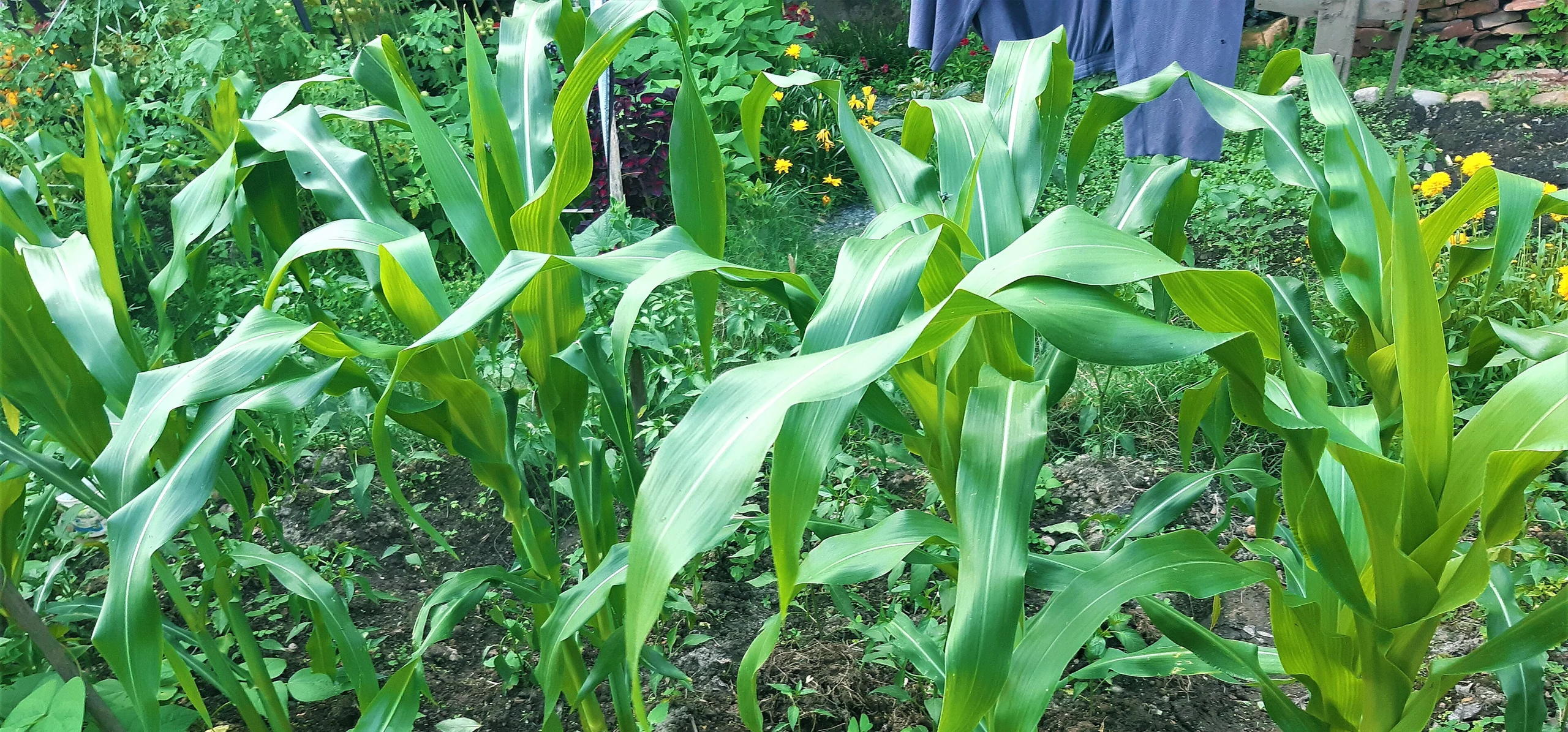
A sweetcorn seedling looks like a single blade of grass for its first couple of weeks, then the true leaves fan out and the stem visibly thickens. Zea mays is a warm-season annual grass, not a vegetable in the botanical sense, and almost everything about growing it follows from that: it needs real heat to germinate, it is pollinated by wind rather than by insects, and a lone plant or a thin single row rarely fills out a proper cob. Get the block planting right and keep up the feed and water through tasselling and silking, and even a first attempt usually comes home with sweet, well-packed ears.
One Grass Behind Sweetcorn, Field Corn and Popcorn
According to GBIF, Zea mays L. sits in the family Poaceae, genus Zea, order Poales, the accepted name for a species with a long list of historic synonyms, including Mays americana and Thalysia mays. Plants of the World Online (Kew) records its native range as central and southwest Mexico to western Guatemala, where its wild ancestor teosinte still grows; the crop planted worldwide today is a domesticate bred from that wild grass over thousands of years. Sweetcorn, picked and eaten fresh off the cob, is only one form of the same species. Field corn (dent and flint types) is grown for grain and animal feed, popcorn has a hard, moisture-trapping hull that makes the kernel burst when heated, and ornamental corn is grown purely for its coloured cobs or striped foliage. All of them grow the same way in the garden; they are just harvested, or left standing, differently.
Sowing Warm and Planting in Blocks, Not Rows
Corn will not germinate reliably in cold soil. The RHS recommends sowing outdoors only once the soil is above 10°C (50°F), and starting seed indoors instead, singly in deep modules or pots at 18 to 21°C, about three weeks before the last frost, where the outdoor season is short. Seed goes in around 2.5cm deep. The detail that catches out first-time growers is the layout: because corn is wind-pollinated, with pollen shed from the tassel at the top falling onto the silks lower down, a single long row often loses its pollen to the wind before it reaches a silk. Plant instead in a block of at least three or four short rows side by side, spaced about 34 to 45cm apart each way, so pollen from any plant drifts onto its neighbours rather than off into empty air. A dozen plants grouped in a block pollinate far more reliably than the same dozen strung along one row.


Feeding, Watering and Earthing Up
Corn is a hungry, thirsty crop for its size. University of Maryland Extension recommends working compost into the bed before planting, then side-dressing with nitrogen twice, once when plants are 30 to 45cm tall and again as the tassels appear; a plant running short of nitrogen shows it first in pale, yellowing lower leaves. Most extension services aim for a soil pH of 6.0 to 6.5. Watering matters most at two points: while the tassels are shedding pollen, and while the silks are receptive and the ears are filling, since a dry spell at either stage leaves ears with gaps or unfilled tips. As the stems grow, drawing soil up around the base of each plant, earthing up, gives the brace roots that develop above ground extra anchorage against wind and heavy rain; it is worth doing once, when plants are knee-high. Corn also throws side shoots, or tillers, low on the stem, and despite the temptation to snap them off like tomato side shoots, University of Maryland Extension notes that removing them has, in trials, sometimes reduced yield rather than improved it, so the simplest approach is to leave them be.
Harvest, the Milky Kernel Test and Supersweet Isolation
Ripeness is not something to guess by the calendar. Wait until the silks have turned brown and started to dry, then peel back part of the husk and pierce a kernel with a thumbnail: clear liquid means the ear is still immature, a milky liquid means it is ready, and a thick, pasty liquid means it has gone past its best. Cobs picked at the milky stage taste noticeably sweeter than ones left even a few days too long, since sugar in the kernel starts converting to starch as the ear ripens, faster still once picked. Supersweet varieties, bred to hold their sugar longer after picking, need to be kept well away from standard sweet corn while flowering. University of Maryland Extension recommends a separation of around 400 yards, or staggering sowing dates by two weeks, since cross-pollination between the two types leaves supersweet ears starchy rather than sweet.
The Three Sisters and Other Companions
Corn's tall, hollow stem is the original trellis in the Three Sisters system used by Indigenous peoples across the Americas: climbing beans grow up the cornstalk instead of needing their own support, while sprawling squash spreads over the ground between the corn, shading out weeds and holding moisture in the soil. The three crops make different demands on the plot rather than competing directly, with the beans returning some of the nitrogen the corn draws on heavily. In a smaller bed, the same logic still applies without a full three-way planting: keep tall corn from shading sun-hungry neighbours, and let a low, spreading crop use the ground corn's narrow footprint leaves bare.
Pests: Birds, Mammals, Earworm and Corn Borer
Freshly sown seed and young seedlings are vulnerable to slugs, which can strip a seedling back to nothing within a night or two, so the usual slug controls are worth applying early. Once cobs are swelling, the RHS lists birds, mice, rats and, in the UK, badgers among the animals that go after a ripening ear, best solved with netting or fencing rather than sprays; in North America, raccoons play the same role. The corn earworm and European corn borer are the insects most associated with damaged ears in North American gardens: earworm caterpillars work down through the silk channel to feed at the cob tip, while corn borer larvae tunnel inside the stalk, sometimes causing it to snap. University of Maryland Extension lists both, along with corn rootworm and Japanese beetles, among the routine problems of a home corn patch; cutting the damaged tip off an earworm-affected cob is often enough, since the kernels underneath are unaffected.
Smut, Rust and a Word on Dogs and Cobs
The most distinctive corn disease is smut, caused by the fungus Ustilago maydis. Iowa State University Extension describes pale, lumpy galls that swell on ears, stems or tassels and eventually burst, releasing fine black spores. It looks alarming, but in Mexican cuisine the young, still-pale galls are harvested deliberately and eaten as huitlacoche, prized as a delicacy rather than treated as a loss. A gardener who does not want it should remove galls by hand while still firm, before they burst, and never add them to the compost heap. Rust, also listed among the RHS's sweetcorn problems, shows as rusty orange pustules on the leaves and is mostly cosmetic on a crop grown for its cobs. Corn itself does not appear on the ASPCA's lists of toxic plants for cats, dogs or horses, so the plant and its kernels are not a poisoning risk. The real hazard for dogs is mechanical, not chemical: a whole cob, or a large chunk of one, swallowed can lodge in the intestine and cause a genuine blockage, a reason to keep spent cobs out of reach rather than a reason to avoid growing it.
Test your plant knowledge
Tap a card to flip it and reveal the answer.
Corn planted in one long single row usually pollinates as well as the same number of plants grown together in a block. Tap to reveal ✕ False
The silks of a corn plant are pollinated by pollen shed from the tassel at the top, carried by wind rather than by insects. Tap to reveal ✓ True
Snapping off the side shoots, or tillers, that grow from the base of a corn stem reliably increases cob size. Tap to reveal ✕ False
Growing a supersweet corn variety too close to standard sweet corn can leave the supersweet cobs starchy instead of sweet. Tap to reveal ✓ True
Corn smut galls are always a total loss and should never be eaten. Tap to reveal ✕ False
Sources
References consulted for this guide
- GBIF: Zea mays L.gbif.org
- POWO (Kew): Zea mays L.powo.science.kew.org
- RHS: How to Grow Sweetcornrhs.org.uk
- University of Maryland Extension: Growing Sweet Corn in a Home Gardenextension.umd.edu
- Iowa State University Extension: Corn Smutyardandgarden.extension.iastate.edu
- Reference entity : Wikipédiaen.wikipedia.org