Zinnia
Zinnia elegans
Family · Asteraceae
Zinnia elegans grows fast from direct-sown seed in full sun. Get spacing for airflow, base watering to dodge leaf spot, and deadheading tips.
Zinnia elegans
Plant profile
- WateringModerateWater every 7 days
- Light exposureFull sun
Growth
- Family
- Asteraceae
- Life cycle
- Annual
- Growth speed
- 8/10
- Mature size
- 20–90 cm
- Spread
- 20–40 cm
- Flowering
- Summer to first frost, about 8-12 weeks after sowing
- Propagation
- Seed
Dormancynone; a frost-tender annual that completes its life cycle in a single growing season
Time to maturityAbout 8 to 12 weeks from sowing to first bloom once soil is warm (Clemson HGIC; RHS)
Soil & climate
- Soil types
- fertile, organically rich, well-drained
- Drought tolerance
- No
Light & Placement
- Origin
- Mexico to Nicaragua (POWO)
- Where to place it
- sunny border or cutting garden bed
- large container in full sun
- large container with well-drained potting mix
Safety
- Toxicity
- CatsSafe
- DogsSafe
- HorsesSafe
Invasive speciesNot listed as invasive; a cultivated annual grown fresh from seed each year rather than one that persists or spreads.
Data fromGBIF: Zinnia elegans Jacq.POWO (Kew): Zinnia elegans Jacq.RHS: How to Grow ZinniaClemson HGIC: How to Grow Zinnias, Best ASPCA: Zinnia toxicity to cats, dogs and
Where it grows
World distribution
Zinnia is native to 6 countries: Belize, El Salvador, Guatemala, Honduras, Mexico, and Nicaragua.GBIF records 10,502 documented identifications across 174 countries, with the largest concentrations in Mexico, United States, and Brazil.
- Belize
- El Salvador
- Guatemala
- Honduras
- Mexico
- Nicaragua
Yellow to orange dots: concentration of documented identifications per country. Green countries: sourced native range. Source: GBIFNative range from POWO (Kew).
A zinnia seedling bought in late spring is often already showing its first flower bud, and within a few weeks in the ground it can be covered in blooms on stiff, upright stems. Zinnia elegans is one of the fastest annuals to reward a new gardener: seed sown once the soil has warmed comes into flower in about eight to twelve weeks, and a plant kept deadheaded will keep producing until the first frost. The trade-off for that speed is a real sensitivity to wet leaves, almost everything that goes wrong with zinnias, from leaf spot to powdery mildew, traces back to foliage that stays damp for too long.
A Mexican Annual With Two Latin Names
According to GBIF, the accepted name for the common garden zinnia is Zinnia elegans Jacq., placed in the daisy family Asteraceae, genus Zinnia, order Asterales. The name Zinnia violacea Cav. turns up on plenty of older labels and in some regional floras; GBIF records it as a synonym of Zinnia elegans rather than a separate species, the two names were coined within a year of each other in the 1790s for the same Mexican wildflower, and which one has priority has been argued over ever since. This guide follows the GBIF-accepted Zinnia elegans, the name used on virtually every modern seed packet. Plants of the World Online (Kew) records the species as native from Mexico to Nicaragua, where it still grows wild as a roadside and scrubland annual, long before breeding turned it into the dense, many-petalled bedding and cut-flower plant sold today.
Choosing a Variety: Height and Disease Resistance
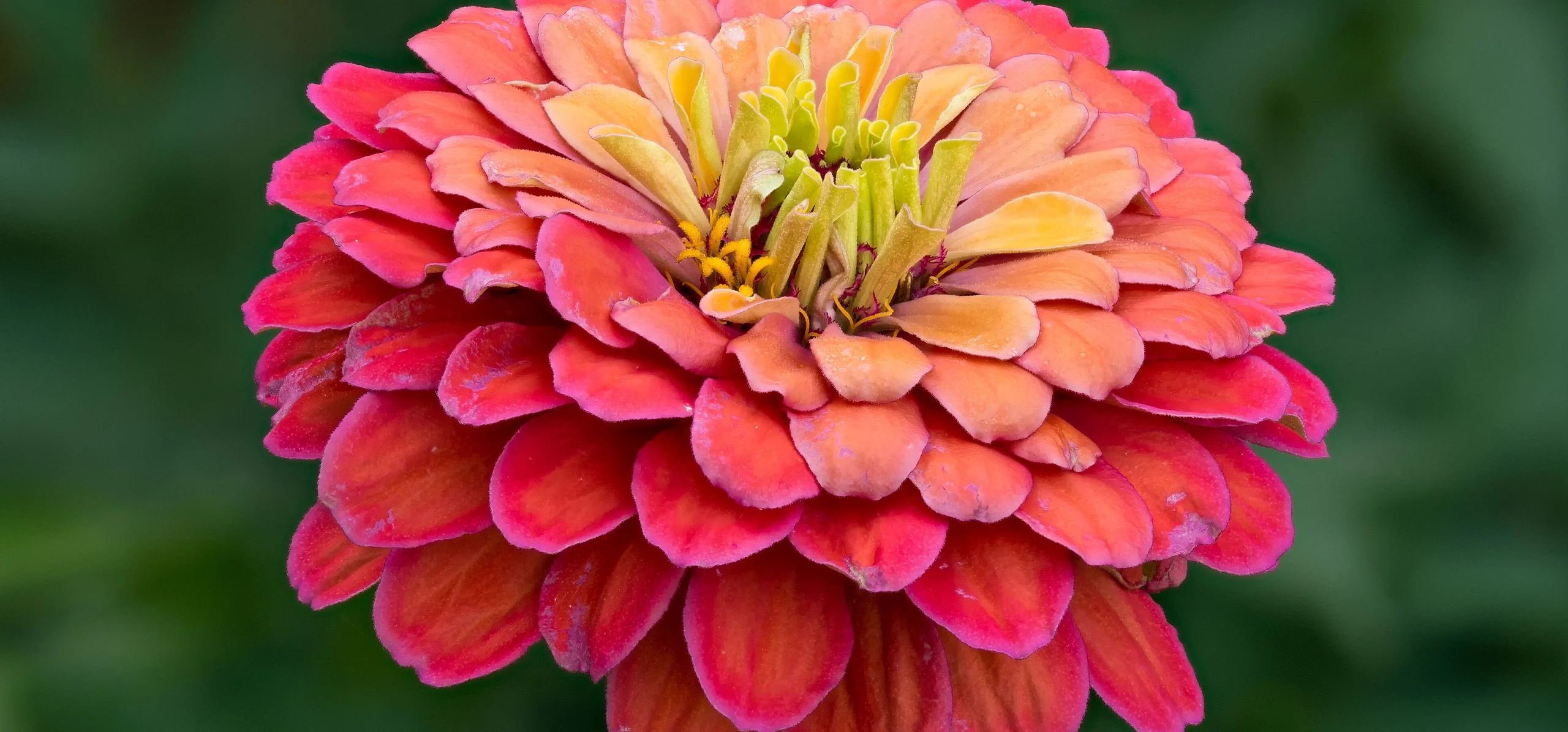
The wild species carries a single ring of petals around a flat central disc, but almost nothing sold in catalogues still looks like that. Dwarf bedding types stay under 30cm and suit the front of a border or a windowbox; tall cutting varieties such as 'Benary's Giant' push past a metre and need staking in an open site. Clemson Cooperative Extension singles out the Profusion hybrids, the Zahara series, 'Dreamland', 'State Fair Giant' and the Oklahoma series as cultivars bred for stronger resistance to powdery mildew and leaf spot, worth seeking out if a previous crop struggled with disease. Double and semi-double, dahlia-flowered forms, densely packed with rounded petals, are the showiest for cutting but hold rainwater on their tightly layered faces longer, which matters in a humid or rainy garden.


Sowing Direct Once the Soil Is Warm
Zinnias resent root disturbance, so direct sowing outdoors, once night frosts are over, usually outperforms transplanting. Clemson recommends waiting until the soil has warmed to around 21°C (70°F) before sowing. Seed goes in about a quarter of an inch (0.6cm) deep, barely covered, and the RHS notes that sowing in late April or early May typically brings plants into flower around twelve weeks later. Where the season is short, seed can be started indoors three to four weeks ahead in modules, but the young plants should go out while still small, older seedlings sulk and stall after the move.
Spacing for Airflow, Not Just Looks
How far apart to plant is a disease decision as much as a design one. Clemson recommends about 8 to 9 inches between dwarf cultivars and at least 12 inches for varieties that reach 2 to 3ft, with a full foot left between rows. The RHS gives a similar figure for block planting, 30 to 40cm apart. Crowded zinnias trap humidity between the leaves, and that stagnant, damp air is exactly what lets fungal leaf spot and powdery mildew take hold; thinning seedlings properly, even when it feels wasteful to pull healthy plants, pays off by midsummer.
Watering at the Base, Never Overhead
Established zinnias need about 1 inch (2.5cm) of water a week, and Clemson is specific that it should go on at the base of the plant rather than over the top. The RHS gives the same advice from the other direction: water freely in hot, dry weather but try not to wet the foliage. Wet leaves are the single biggest risk factor for the fungal and bacterial diseases zinnias are prone to, so a soaker hose or a watering can with a low spout beats an overhead sprinkler every time, and watering in the morning, so any splashed leaves dry out before evening, is safer than watering late in the day.
Feeding, Pinching and Deadheading for Nonstop Bloom
A zinnia grown in reasonably fertile soil needs little extra feeding; the RHS recommends a high-potassium feed, such as a tomato fertiliser, once plants are in flower, mainly for container-grown plants rather than open ground. Pinching out the growing tip of a young plant once it has three or four sets of true leaves encourages side branches and a bushier, more floriferous habit rather than one tall central stem. Deadheading matters more than feeding for keeping the display going: the RHS advises snipping a fading flower back to the next side branch as soon as it starts to lose colour, letting the branch behind it develop, and Clemson notes that removing spent blooms is what keeps a planting flowering over a long season instead of setting seed and stopping.
Pests and Diseases to Watch For
Seedlings are the most vulnerable stage: damping off can wipe out a tray overnight in cool, wet conditions, and slugs will strip young leaves to nothing given the chance. On established plants, Clemson lists the same trio of foliar problems most home growers run into: powdery mildew, a grey-white coating usually worst late in the season; Alternaria leaf spot (Alternaria zinniae), reddish-brown spots that enlarge into ragged, grey-centred patches; and bacterial leaf spot (Xanthomonas campestris pv. zinniae), angular brown lesions ringed with yellow. All three spread faster on wet foliage and in crowded plantings, which is why watering technique and spacing do more for zinnia health than any spray. Removing and binning infected leaves as soon as they appear, rather than composting them, keeps spores from overwintering in the bed.
Cutting Zinnias for the Vase and a Toxicity Check
Zinnias are a classic cut-and-come-again flower: cutting stems for a vase has the same effect as deadheading, prompting more blooms rather than fewer. Cut in the morning when stems are turgid, choosing flowers whose petals have already fully opened and flattened, since zinnias, unlike some cut flowers, stop developing once removed from the plant and will not open further in water. The common zinnia is listed by the ASPCA as non-toxic to cats, dogs and horses, so an occasional nibble from a curious pet or a stem left within reach of a grazing horse is not a poisoning concern, though any plant eaten in quantity can still upset a stomach.
Test your plant knowledge
Tap a card to flip it and reveal the answer.
Zinnias should be watered overhead in the evening to help cool the foliage. Tap to reveal ✕ False
Zinnia elegans typically comes into flower within about eight to twelve weeks of sowing. Tap to reveal ✓ True
Planting zinnias close together improves air circulation between the leaves. Tap to reveal ✕ False
The ASPCA lists the common zinnia as non-toxic to cats, dogs and horses. Tap to reveal ✓ True
Deadheading spent zinnia blooms encourages the plant to keep flowering. Tap to reveal ✓ True
Sources
References consulted for this guide
- GBIF: Zinnia elegans Jacq.gbif.org
- POWO (Kew): Zinnia elegans Jacq.powo.science.kew.org
- RHS: How to Grow Zinniarhs.org.uk
- Clemson HGIC: How to Grow Zinnias, Best Varieties & Care Tipshgic.clemson.edu
- ASPCA: Zinnia toxicity to cats, dogs and horsesaspca.org
- Reference entity : Wikipédiaen.wikipedia.org