Common Ragwort
Jacobaea vulgaris
Family · Asteraceae
Common ragwort (formerly Senecio jacobaea) is toxic to horses via pyrrolizidine alkaloids and a UK injurious weed. How to identify, remove and manage it.
Jacobaea vulgaris
Plant profile
- WateringLittleWater every 10 days
- Light exposureFull sun
Growth
- Family
- Asteraceae
- Life cycle
- Biennial
- Growth speed
- 7/10
- Mature size
- 15–150 cm
- Flowering
- Flat-topped clusters of yellow, daisy-like flowers from July to October
- Propagation
- Seed
DormancyOverwinters as a low leaf rosette; sends up a flowering stem in its second year
Time to maturityFlowers in its second year, roughly 15 cm to 1.5 m tall, from July to October
Soil & climate
- Soil types
- sand dunes, grassland, pasture, roadside verges, wasteland
- Drought tolerance
- Yes
Light & Placement
- Origin
- Europe to Mongolia and Caucasus
- Where to place it
- grassland
- pasture edges
- roadside verges
- wasteland
- sand dunes
Safety
- Toxicity
- CatsToxic
- DogsToxic
- HorsesToxic
Invasive speciesListed as an injurious weed under the UK's Weeds Act 1959, with a statutory Code of Practice under the Ragwort Control Act 2003 governing its spread near grazing land.
Data fromGBIF: Jacobaea vulgaris Gaertn.Plants of the World Online (Kew): JacobaRHS: RagwortASPCA: Toxic and Non-Toxic Plants, RagwoOregon State University Extension: Tansy
Where it grows
World distribution
Common Ragwort is native to 36 countries: Albania, Austria, Belarus, Belgium, Bulgaria, China, Croatia, and Czechia….GBIF records 805,390 documented identifications across 67 countries, with the largest concentrations in United Kingdom, Netherlands, and France.
- Albania
- Austria
- Belarus
- Belgium
- Bulgaria
- China
- Croatia
- Czechia
- Denmark
- Estonia
- Finland
- France
Show 24 more countriesShow fewer countries
- Georgia
- Germany
- Greece
- Hungary
- Ireland
- Italy
- Kazakhstan
- Kyrgyzstan
- Mongolia
- Morocco
- Netherlands
- Norway
- Poland
- Portugal
- Romania
- Russia
- Spain
- Sweden
- Switzerland
- Tajikistan
- Türkiye
- Ukraine
- United Kingdom
- Uzbekistan
Yellow to orange dots: concentration of documented identifications per country. Green countries: sourced native range. Source: GBIFNative range from POWO (Kew).
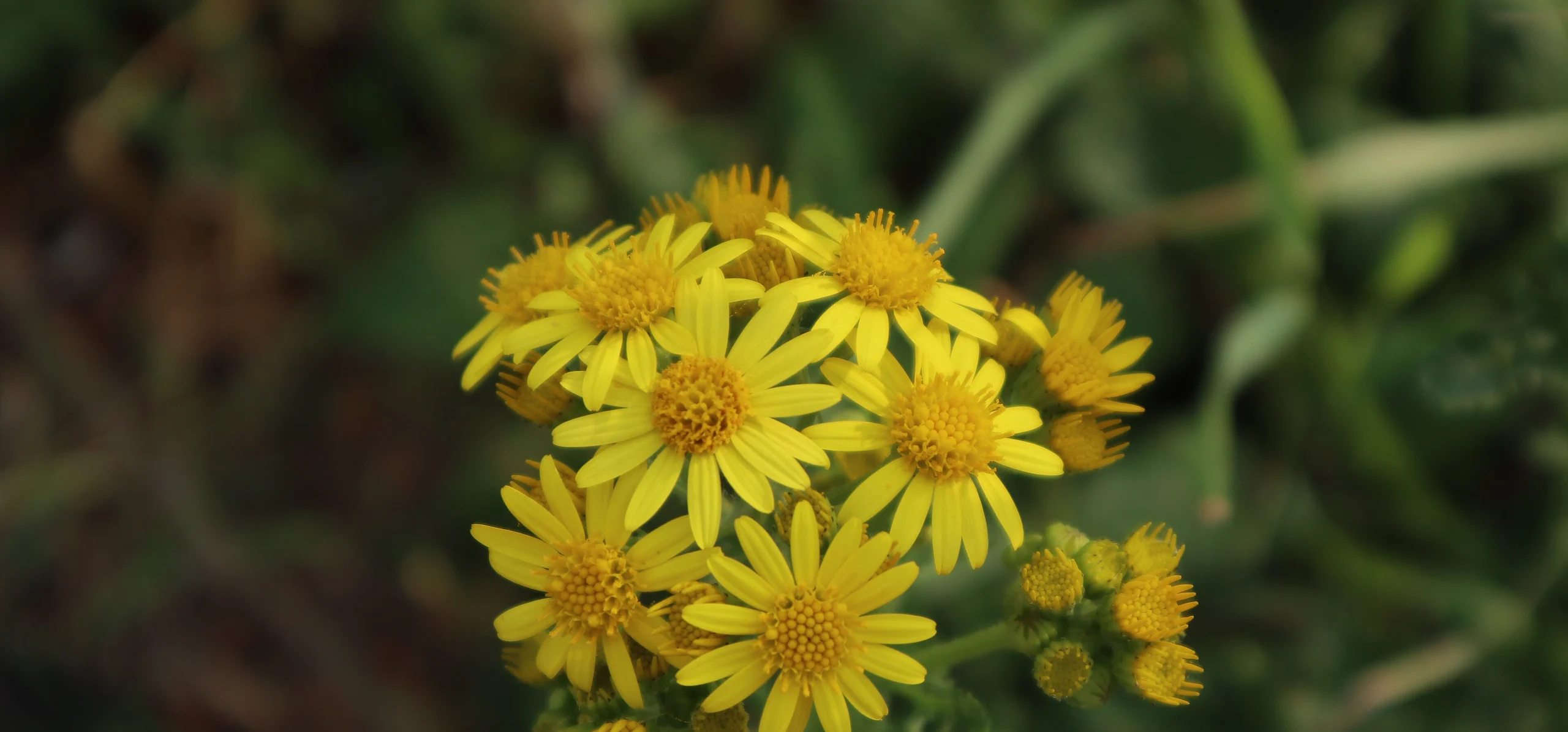
A rosette of deeply lobed, dark green leaves that bolts into a flat-topped head of small yellow daisies by midsummer, usually in its second year: that is common ragwort, and a stand of it on a horse paddock or grazed field margin is worth acting on quickly. Jacobaea vulgaris is the accepted botanical name; most horse owners still know the plant as Senecio jacobaea. It carries pyrrolizidine alkaloids that make green or dried plant material capable of causing fatal liver damage in horses and cattle. It is also, less dramatically, the single most important food plant for cinnabar moth caterpillars and a draw for bees and butterflies, which is part of why its control is regulated rather than simply encouraged.
Identifying Common Ragwort
In its first year, ragwort grows only as a low rosette of feathery, deeply lobed, dark green leaves that overwinters at ground level. In the second year that rosette sends up a flowering stem reaching roughly 15 cm to 1.5 m tall depending on conditions, according to the RHS and Oregon State University Extension. The flowers open from July to October in large, flat-topped clusters of yellow, daisy-like heads, each with around 15 ray petals surrounding a darker centre disc. A single mature plant can set 100,000 seeds or more, each carried on a tuft of hairs built for wind dispersal, which is why one unmanaged plant can seed an entire field margin within a couple of seasons.
Why Ragwort Is Dangerous to Horses and Livestock
The danger comes from pyrrolizidine alkaloids, present in the plant fresh or dried. The RHS states that ingestion by grazing animals can cause serious liver damage and can be fatal, a risk that extends to related species such as marsh and hoary ragwort. The ASPCA's profile for ragwort describes the same alkaloids causing progressive liver failure, sometimes called "walking disease" or "sleepy staggers": animals often look normal at first, then decline over days to a week, with weight loss, weakness, yawning, incoordination and yellowing of the mucous membranes as the liver fails. Ragwort is not very palatable fresh, so poisoning usually happens when animals have no other forage, or when ragwort is baled into hay, where the plant is just as toxic and harder to pick out and avoid. Oregon State University Extension adds that cattle and horses are most at risk, while sheep and goats are comparatively less susceptible, though not risk-free.
Legal Status: The Weeds Act and the Ragwort Control Act
In the UK, common ragwort is one of five plants named an injurious weed under the Weeds Act 1959, a list that also includes spear thistle, creeping thistle, curled dock and broad-leaved dock. The Ragwort Control Act 2003 added a Code of Practice on preventing its spread, and the RHS notes that failure to follow it can be used as evidence in legal proceedings against a landowner whose ragwort has spread onto neighbouring grazing land. None of this makes growing ragwort illegal outright: the legislation targets its spread near horses and livestock, not the plant growing in a wild corner with no paddock nearby. In parts of the United States, Oregon State University Extension describes tansy ragwort as a widespread invasive weed that land managers are expected to actively control, with dedicated biological control programmes running since the plant became established on the west coast.


Removing Ragwort by Hand: Timing Beats Cutting
The RHS's clearest piece of practical advice is also the most counterintuitive: do not just cut ragwort down. Cutting a flowering stem removes the immediate seed threat but tends to push the plant into behaving as a perennial instead of dying back after flowering as it normally would, so a cut patch can return thicker the following year. The better window is the first year, while the plant is still a leaf rosette with no flowering stem: hoeing seedlings before they establish, or hand-pulling and digging out rosettes, deals with the problem before it can set seed at all. Oregon State University Extension recommends digging out plants by the roots while the soil is moist, when the root system lifts cleanly, and disposing of the pulled material in the trash or at a landfill rather than the compost heap, since alkaloid-laden plant matter and viable seed can both survive home composting. A 10 cm layer of organic mulch over a border where ragwort has been a problem, as recommended by the RHS, helps stop the next flush of seedlings from establishing.
Biological Control: Cinnabar Moths and Flea Beetles
Where mechanical control is not practical across large areas, three insects have been deployed specifically against ragwort: the cinnabar moth (Tyria jacobaeae), whose orange-and-black striped caterpillars can strip a plant to a bare stem; the ragwort flea beetle (Longitarsus jacobaeae), whose larvae feed inside the roots while adults chew small holes in the leaves; and the ragwort seedhead fly (Botanophila seneciella), whose larvae destroy developing seeds from inside the seed head. Oregon State University Extension reports that sites where flea beetles were released have seen more than 90 percent control of tansy ragwort after seven years, and describes the wider biological control programme on the West Coast as a major success story. The gains are not universal: the same extension service notes the weed is still expanding into colder interior regions of the Pacific Northwest, where the same insects have so far failed to establish.
Ragwort's Ecological Value Beyond the Warning Labels
Strip away the livestock warnings and ragwort is one of the more valuable wildflowers on a British verge or hedgerow bank: the RHS records more than 200 species of invertebrates on it, and it is the primary food plant for the day-flying cinnabar moth, whose black-and-orange-striped caterpillars feed in visible clusters through summer. The same flat-topped flower heads that make ragwort easy to identify are also a strong nectar and pollen source for bees and butterflies later in the season, when many other roadside plants have finished flowering. That ecological value is exactly why the plant is managed rather than eradicated on sight in most settings: pulling every ragwort plant from a verge or wild corner with no grazing animals nearby trades a genuine wildlife resource for a risk that, in that setting, does not really exist.
Common Mistakes
- Composting pulled ragwort. Home compost heaps rarely get hot enough to reliably destroy ragwort seed or break down its alkaloids; Oregon State University Extension recommends binning or landfilling pulled plants instead.
- Cutting instead of pulling. As the RHS notes, cutting a flowering stem tends to make ragwort behave as a perennial rather than dying back naturally, so a cut patch often returns thicker the next year.
- Assuming a horse will avoid it. Ragwort is not especially palatable fresh, per the ASPCA and RHS, but animals eat it anyway when grazing is short, or unknowingly in hay, where it is just as toxic and harder to spot.
- Treating every sighting as an emergency. Away from paddocks and hay fields, a patch left standing in a verge or wild corner is feeding cinnabar moth caterpillars and pollinators rather than posing a livestock risk.
- Ignoring sheep and goats on the same ground. They are less susceptible to ragwort poisoning than horses and cattle, per Oregon State University Extension, but less susceptible is not safe, and mixed grazing does not remove the need to control it.
Test your plant knowledge
Tap a card to flip it and reveal the answer.
Common ragwort usually flowers and dies in its second year, behaving as a biennial. Tap to reveal ✓ True
Sheep and goats are just as susceptible to ragwort poisoning as horses and cattle. Tap to reveal ✕ False
In the UK, common ragwort is named an injurious weed under the Weeds Act 1959. Tap to reveal ✓ True
Cutting a flowering ragwort stem reliably kills the plant before it can regrow. Tap to reveal ✕ False
Cinnabar moth caterpillars feed on ragwort and can strip a heavily infested plant to a bare stem. Tap to reveal ✓ True
Sources
References consulted for this guide
- GBIF: Jacobaea vulgaris Gaertn.gbif.org
- Plants of the World Online (Kew): Jacobaea vulgaris Gaertn.powo.science.kew.org
- RHS: Ragwortrhs.org.uk
- ASPCA: Toxic and Non-Toxic Plants, Ragwortaspca.org
- Oregon State University Extension: Tansy Ragwortsolvepestproblems.oregonstate.edu
- Reference entity : Wikipédiaen.wikipedia.org