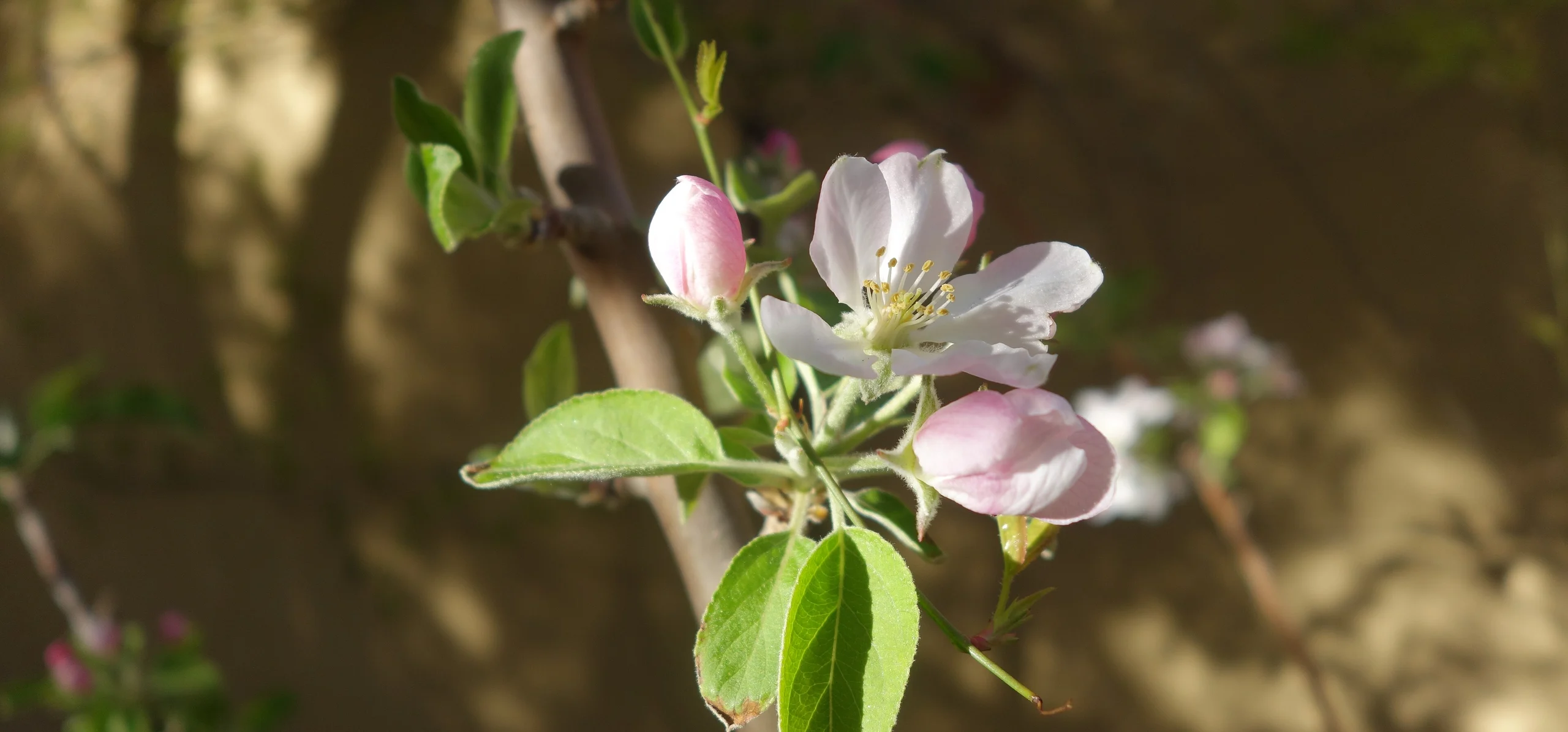
Apple Tree
Malus domestica
Family · Rosaceae
Apple tree care: pick a rootstock (M9 to M25), plant a pollination partner, prune by tree shape, thin fruit, and watch for codling moth and scab.
Malus domestica
Plant profile
- WateringModerateWater every 10 days
- Light exposureFull sun
- Hardiness zoneUSDA 4–9
Growth
- Family
- Rosaceae
- Life cycle
- Perennial
- Growth speed
- 5/10
- Mature size
- 180–900 cm
- Spread
- 270–900 cm
- Propagation
- Grafting
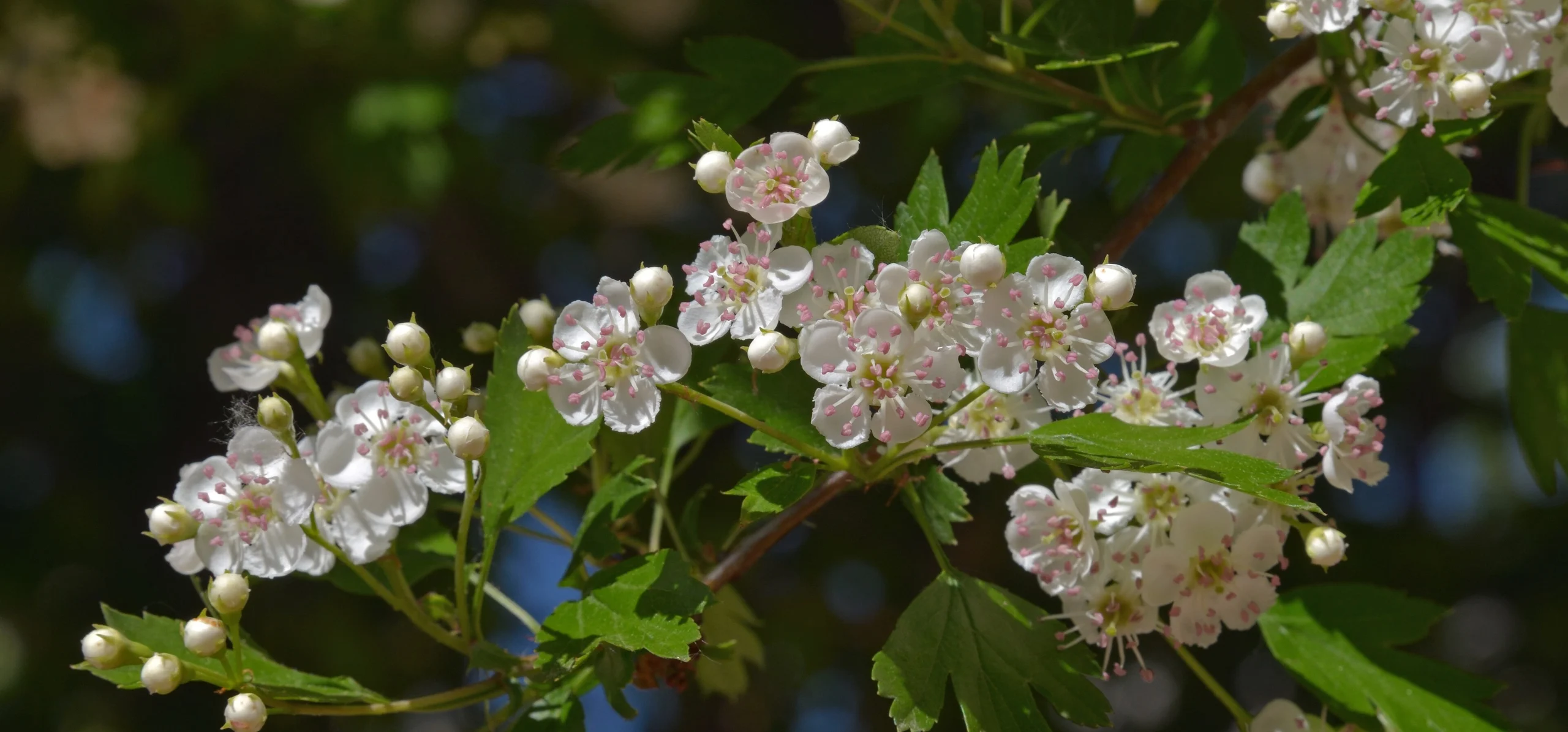
FloweringSpring blossom, white flushed pink, about 2.5 to 4 cm across (NC State Extension); fruit ripens summer to autumn depending on variety
Dormancydeciduous, bare in winter
Time to maturityfruits after two or three years on M9 or M26 dwarfing rootstock, three to four years on MM106, five to six years on vigorous M25 rootstock (RHS)
Soil & climate
- Soil pH
- pH 6–7.5
- Soil types
- loam, clay, sand
- Saline soil
- Not tolerated
- Drought tolerance
- No
Light & Placement
- Origin
- Afghanistan to Central Asia and Xinjiang (POWO)
- Where to place it
- open sunny garden bed or orchard row
- trained flat against a sunny wall or fence (cordon, espalier, fan)
- container at least 45 cm (18 in) across on M9 or M26 dwarfing rootstock, loam-based compost (RHS)
Safety
- Toxicity
- CatsToxic
- DogsToxic
- HorsesToxic
Data fromGBIF Backbone Taxonomy: Malus domestica POWO (Kew): Malus domestica (Suckow) BorRHS: How to grow applesRHS: Rootstocks for fruitASPCA: Toxic and Non-toxic Plants, AppleNC State Extension Gardener Plant Toolbo
Where it grows
World distribution
Apple Tree is native to 7 countries: Afghanistan, China, Kazakhstan, Kyrgyzstan, Pakistan, Tajikistan, and Uzbekistan.GBIF records 219,192 documented identifications across 104 countries, with the largest concentrations in United Kingdom, Germany, and Sweden.
- Afghanistan
- China
- Kazakhstan
- Kyrgyzstan
- Pakistan
- Tajikistan
- Uzbekistan
Yellow to orange dots: concentration of documented identifications per country. Green countries: sourced native range. Source: GBIFNative range from POWO (Kew).
An apple tree bought as Malus pumila and one bought as Malus domestica are the same plant. GBIF's Backbone Taxonomy accepts domestica as the correct name and treats pumila as a synonym, a conservation ruling the International Association for Plant Taxonomy approved in 2017 because domestica had already become the standard name in modern literature. Kew's Plants of the World Online traces its native range to Afghanistan, Central Asia and Xinjiang, where its wild ancestor Malus sieversii still grows. What matters more on day one is the rootstock grafted below the variety, since that piece of wood, not the label, decides whether the tree tops out at 2 m in a pot or 9 m in open ground.
Rootstock First: What Actually Controls Size
Nearly every apple tree sold today is a variety grafted onto a separate rootstock, and the rootstock, not the variety, sets the mature size. The RHS lists M9 as the most dwarfing common rootstock, reaching 1.8 to 2.4 m tall and 2.7 m wide, and coming into fruit after two or three years, which makes it the standard choice for a small garden, a cordon or a pot. M26 grows slightly larger, 2.4 to 3 m tall, on the same two to three year timetable. MM106, the most widely planted rootstock according to the RHS, produces a semi-dwarf tree 3 to 4 m tall that fruits after three or four years and suits most forms except full standards. At the vigorous end, M25 reaches over 4.5 m and takes five or six years to fruit, and the RHS considers it too large for a typical garden. Ask for the rootstock name before buying: a label that only gives the variety leaves the eventual size to guesswork.
Pollination: Why Most Apples Need a Partner
Most apple varieties are not self-fertile, per the RHS, and need a different variety flowering at the same time nearby to set a worthwhile crop; without one, blossom can open and drop with little or no fruit behind it. Varieties are grouped by flowering time, so the practical rule is to plant two varieties from the same or adjacent pollination group, or choose a self-fertile variety if space allows only one tree. Crab apples, which flower over a long season and cross-pollinate almost anything, are the usual fallback in gardens with room for only one full-size apple. In an orchard, a mix of two or three compatible varieties, plus bees to move the pollen, is what actually turns blossom into fruit; a single self-fertile tree isolated far from any other apple still sets less than one growing with a partner nearby.


Planting and Soil
Plant bare-root apple trees from late autumn to early spring while dormant, the RHS's recommended window, and container-grown trees at the same time if possible, since winter planting gives roots a head start before the growing season's demand for water. The species wants deep, fertile, moist but well-drained soil at a neutral pH, RHS and NC State Cooperative Extension put the tolerable range around pH 6 to 7.5, and it will not thrive on very acid ground, shallow chalk, or a spot shaded more than half the day. Going into a lawn, clear a circle of grass at least 1 m across so grass roots do not compete for water early on. In a pot, use a container at least 45 cm (18 in) across with a loam-based compost such as John Innes No. 3, and stick to a dwarfing rootstock, M9 or M26, since anything more vigorous will outgrow a pot within a few years.
Watering and Feeding
A newly planted apple needs regular watering through dry spells for its first couple of years, the RHS notes, while its roots are still reaching into the surrounding soil; established trees growing in open ground shouldn't need supplemental watering at all except in prolonged drought. Container trees are the exception at every stage: they need a steady, even supply of moisture throughout the growing season, since the compost dries out fast in a pot exposed to full sun. Ground trees mulched annually with organic matter generally need no extra feeding. Potted trees do, either a high-potassium liquid feed every fortnight through the growing season, or a handful of general granular fertiliser sprinkled onto the compost each spring, per the RHS. Keep any mulch pulled back about 10 cm from the trunk so it never sits against the bark, which invites rot.
Pruning by Shape, Not by Calendar
Apple pruning timing depends entirely on the tree's form. Free-standing bush and pyramid trees are pruned in winter, while dormant, to keep the framework open and encourage the following year's fruiting spurs. Trained forms, cordons, espaliers and fans grown flat against a wall or wire, are pruned instead in late summer, a cut that restricts vigorous regrowth rather than stimulating it, which is exactly what a trained shape needs. As a tree matures, typically from about six to eight years old, renewing a portion of the oldest fruiting wood, roughly a fifth to a third of it in a given year, keeps spurs productive rather than letting the whole canopy age into low-yielding wood at once. Whichever form, always cut back to a bud or a junction and remove dead, damaged or crossing branches first; that alone prevents most of the disease problems that enter through careless pruning wounds.
Thinning the Crop for Size and Quality
Left alone, a healthy apple tree sets far more fruitlets than it can properly ripen, and the excess translates directly into smaller apples and, in many varieties, a heavy crop one year followed by almost nothing the next, a pattern called biennial bearing. After the tree's own natural early summer fruit drop, thin what remains to around one apple every 10 to 15 cm along the branch, or roughly one to two fruits per cluster, removing the smallest and any that are damaged or misshapen first. On a young tree in its first couple of fruiting years, it is worth removing nearly everything that sets, since a light early crop lets the tree put its energy into establishing roots and branch structure instead of ripening fruit it is not yet ready to support.
Pests, Disease and the Toxicity Warning
The RHS lists codling moth, whose larvae are the classic cause of maggoty fruit, alongside rosy apple aphid, woolly aphid, apple sawfly and fruit tree red spider mite as the main insect problems, and apple scab, apple canker, fireblight, brown rot and powdery mildew as the recurring diseases; NC State Cooperative Extension adds cedar apple rust and apple maggot to that list for North American gardens. None of these are usually fatal to an established tree on their own, but scab and canker both spread fastest in wet years and on crowded, poorly pruned growth, which is one more reason routine pruning matters. Separately from pests, the ASPCA classifies apple as toxic to dogs, cats and horses: the seeds, stems and wilting leaves contain cyanogenic glycosides, and while the ripe flesh itself is safe, pets that chew through fallen fruit and pips can develop stomach upset or, rarely, more serious signs, so clearing windfalls is worth the ten minutes it takes.
Test your plant knowledge
Tap a card to flip it and reveal the answer.
Most apple varieties need a different variety flowering at the same time nearby to set a worthwhile crop. Tap to reveal ✓ True
An apple tree on M9 rootstock typically grows into a full-size tree over 4 metres tall. Tap to reveal ✕ False
The RHS recommends winter pruning for free-standing apple trees and late-summer pruning for trained forms like cordons. Tap to reveal ✓ True
Apple seeds, stems and wilting leaves contain compounds that make the tree toxic to dogs, cats and horses. Tap to reveal ✓ True
Established apple trees growing in open ground typically need regular extra watering even in ordinary weather. Tap to reveal ✕ False
Sources
References consulted for this guide
- GBIF Backbone Taxonomy: Malus domestica (Suckow) Borkh.gbif.org
- POWO (Kew): Malus domestica (Suckow) Borkh.powo.science.kew.org
- RHS: How to grow applesrhs.org.uk
- RHS: Rootstocks for fruitrhs.org.uk
- ASPCA: Toxic and Non-toxic Plants, Appleaspca.org
- NC State Extension Gardener Plant Toolbox: Malus domesticaplants.ces.ncsu.edu
- UC IPM: Cultural Tips for Growing Appleipm.ucanr.edu
- Reference entity : Wikipédiaen.wikipedia.org