Chicory
Cichorium intybus
Family · Asteraceae
Chicory's taproot becomes radicchio, roasted root coffee, or witloof chicons forced in darkness, while the same species blooms wild and blue along roadsides.
Cichorium intybus
Plant profile
- WateringModerateWater every 7 days
- Light exposureFull sun
- Hardiness zoneUSDA 3–8
Growth
- Family
- Asteraceae
- Life cycle
- Biennial
- Growth speed
- 7/10
- Mature size
- 60–120 cm
- Spread
- 45–60 cm
- Flowering
- Clear blue flowers, mid-summer to first frost, open at dawn and closed by noon
- Propagation
- Seed
DormancyOverwinters as a basal rosette or, for witloof, as a lifted root stored in darkness before forcing
Time to maturityRoots for forcing are lifted about five to six months after a May-June sowing; leaf types and radicchio head up from late summer after a June-July sowing
Soil & climate
- Soil types
- well-drained, clay, loam, sand, rocky, neutral to alkaline
- Drought tolerance
- Yes
Light & Placement
- Origin
- Europe, western Asia and northern Africa
- Where to place it
- open, sunny vegetable bed
- sunny border
- roadside or waste ground (self-sown wild form)
- container at least 30cm (12in) wide, for forcing roots or cut-and-come-again leaves
Safety
- Toxicity
- Not evaluated by the ASPCA; toxicity to pets undetermined
- Pet safe
- No
Invasive speciesNaturalized across fields, pastures, waste areas and roadsides in much of the U.S.; listed on Colorado's Noxious Weed Act (List C), requiring eradication, containment or suppression depending on location.
Data fromGBIF: Cichorium intybus L.Plants of the World Online (Kew): CichorMissouri Botanical Garden Plant Finder: RHS: How to Grow ChicoryNC State Extension Gardener Plant Toolbo
Where it grows
World distribution
Chicory is native to 45 countries: Afghanistan, Albania, Algeria, Austria, Belarus, Belgium, Bulgaria, and Cape Verde….GBIF records 385,791 documented identifications across 122 countries, with the largest concentrations in United States, France, and Netherlands.
- Afghanistan
- Albania
- Algeria
- Austria
- Belarus
- Belgium
- Bulgaria
- Cape Verde
- Croatia
- Cyprus
- Czechia
- Denmark
Show 33 more countriesShow fewer countries
- Egypt
- Estonia
- Finland
- France
- Georgia
- Germany
- Greece
- Hungary
- India
- Iran
- Iraq
- Italy
- Kazakhstan
- Kyrgyzstan
- Lebanon
- Morocco
- Netherlands
- Norway
- Pakistan
- Palestinian Territories
- Poland
- Portugal
- Romania
- Russia
- Spain
- Sweden
- Switzerland
- Tajikistan
- Tunisia
- Türkiye
- Turkmenistan
- Ukraine
- Uzbekistan
Yellow to orange dots: concentration of documented identifications per country. Green countries: sourced native range. Source: GBIFNative range from POWO (Kew).
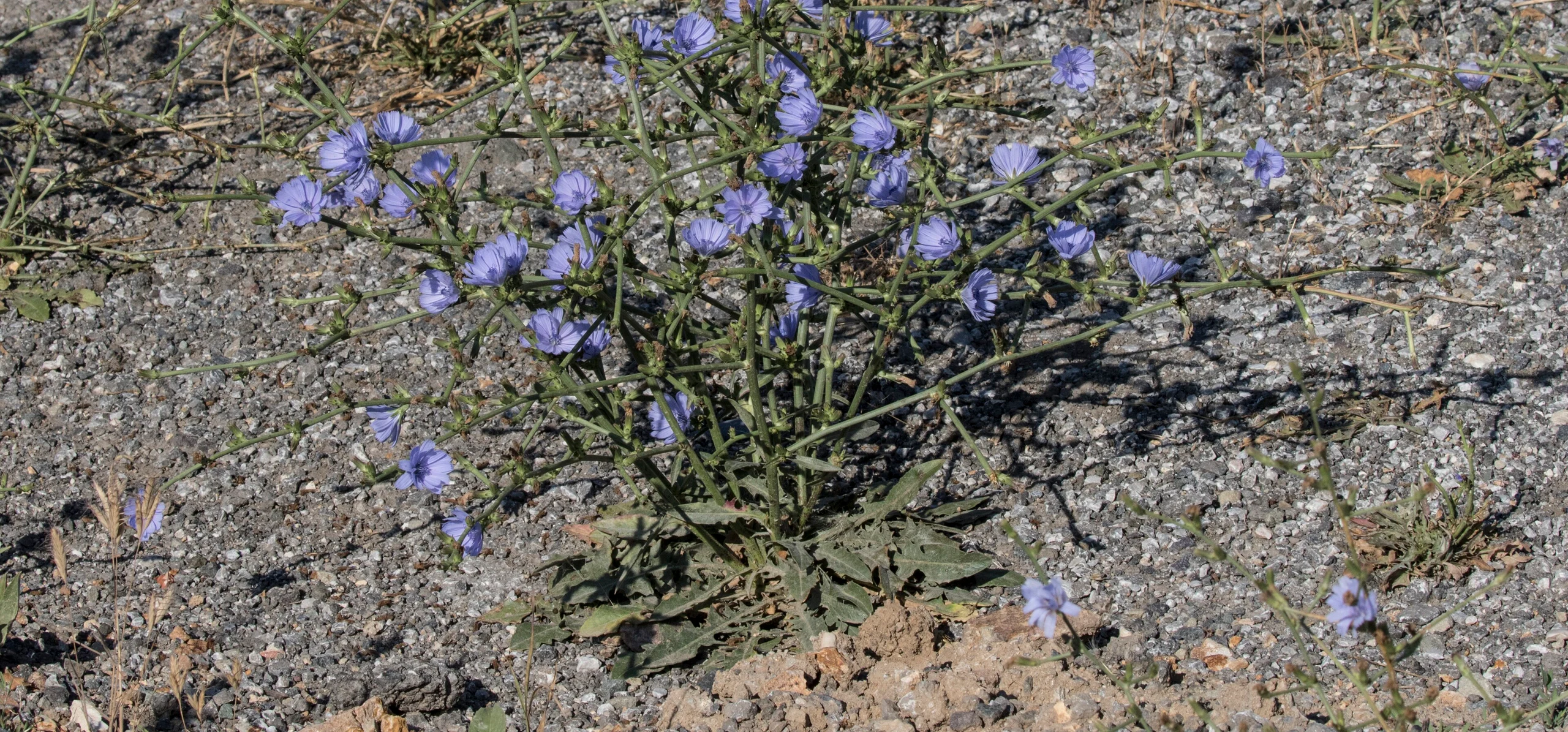
Chicory is sold under several different names because it is grown several different ways from the same species: as a leafy salad head cut for something like a loose-leaf or Sugarloaf type, as radicchio's tight red heads, as a root left in the ground to be dried and roasted into a coffee substitute, and as witloof, whose root is lifted, stored, then forced in complete darkness into the pale, tightly furled buds sold as Belgian endive. Every one of these is the same plant as the wiry, sky-blue-flowered weed that lines gravel shoulders and vacant lots each summer, a species Missouri Botanical Garden's Plant Finder lists as naturalized across most of the United States. Cut into the root of any of them and it bleeds a milky white sap, the same taproot doing different work depending on which crop is wanted. Deciding which one is being grown changes almost everything about sowing, watering, and harvest, covered section by section below.
One Species, Three Cultivated Crops
Cichorium intybus covers three cultivated forms plus the wild roadside form, and a seed packet that just says chicory or endive does not say which one has been bought. Radicchio and the various loose-leaf and Sugarloaf chicories are grown for their heads or leaves, picked green or, in radicchio's case, developing red color as the weather cools; North Carolina State Extension notes the leaves are edible raw or cooked but carry a persistent bitterness that is part of the point rather than a flaw. Root chicory is grown purely for its taproot, left in the ground through the season, then lifted, dried, and roasted for use as a coffee substitute or additive. Witloof, also called Belgian endive, splits the crop into two stages: a root grown all summer like root chicory, then forced indoors over winter into a pale chicon that never sees a growing season's worth of daylight.
Sowing and Spacing
According to RHS guidance, forcing (witloof) varieties are sown outdoors in May and June, seed covered to about 1cm (half an inch), then thinned to 15cm (6in) apart in rows 30cm (12in) apart so each root has room to bulk up over summer. Non-forcing types, the leaf chicories and radicchio, are sown indoors in April and May or direct outdoors in June and July and thinned further apart, to 30cm (1ft), since it is the head rather than the root that needs the space. A cut-and-come-again row of baby leaves only needs 5cm (2in) between plants, since those never get the chance to bulk up before being cut. Whichever form is going in the ground, RHS recommends an open, sunny site that will tolerate some shade in summer, worked with garden compost or well-rotted manure ahead of sowing.


The Taproot and Why Chicory Bolts
The taproot is deep and fleshy, and Missouri Botanical Garden's Plant Finder describes it as exuding a milky sap when cut, the same defense compound responsible for the leaves' bitterness. That root is also why chicory bolts under stress: RHS lists cold early sowings, hot dry weather, and low temperatures right after planting as the most common triggers, and recommends watering thoroughly through dry spells specifically to deter it. The same dry spell that pushes a plant to bolt also concentrates bitterness in the leaves, so a chicory bed that goes short of water is punished twice, once in flavor and once in a wasted root that runs to seed instead of bulking up.
Growing Leaf Chicory and Radicchio
Leaf types and radicchio sown outdoors in June or July are ready from late summer as whole heads, according to RHS, or earlier still if they are cut young as baby salad leaves rather than left to head up. Because the leaves carry the same bitter compound as the root, cooks generally either pair them with something sweet or fatty, or blanch the heads by excluding light in the final weeks, the same principle behind forcing witloof but applied briefly to a leaf crop instead of a stored root. Slugs and snails are the main threat at this stage; both RHS and North Carolina State Extension single them out alongside cutworms as the pests actually worth watching for, and neither source lists any serious disease problem for the species.
Forcing Witloof Into Chicons
Witloof is grown for one purpose only: a root strong enough to force. RHS has the roots lifted in November, and any crown under 2.5cm (1in) across is discarded rather than forced, since a root that thin will not hold enough stored energy to push out a usable chicon. The lifted roots are replanted in pots or beds and covered completely, with black polythene or an inverted bucket, to exclude every trace of light, then held between 10 and 15°C (50 to 59°F). About four weeks later, once the chicon has reached 15cm (6in) tall, it is cut at the crown; RHS's method depends on total darkness for that whole month, which is what keeps the leaves pale and gives forced chicory its name.
Root Chicory as a Coffee Substitute
Root chicory follows the same first summer as witloof, growing a single taproot rather than a head of leaves, but it is never forced. Instead the mature root is lifted, dried, and roasted, a use both Missouri Botanical Garden and North Carolina State Extension confirm is behind chicory's long history as a coffee additive or substitute, particularly where coffee itself was once scarce or costly. The roasted root has little of chicory's fresh bitterness left in it by the time it reaches a cup, but it is the same milky-sapped taproot as every other form of the plant, taken to a different endpoint.
Pollinators and the Wild Roadside Flower
Left alone rather than harvested, chicory's blue flowers open in the morning and close by noon unless the day is cloudy, a rhythm North Carolina State Extension documents directly, which is also why a chicory patch photographed in the afternoon often shows nothing but closed buds. Bees and butterflies nectar at the flowers during that open window, per the same source, making the plant a minor but reliable forage source wherever it has naturalized along roadsides, fields, and waste ground. That naturalizing habit has a downside: Missouri Botanical Garden notes chicory is significant enough as a weed to be listed on Colorado's Noxious Weed Act, where it must be eradicated, contained, or suppressed depending on location, so a gardener who lets a cultivated patch set seed near open ground is releasing the same wild form back into the landscape rather than growing an ornamental.
Test your plant knowledge
Tap a card to flip it and reveal the answer.
Belgian endive (witloof) chicons are forced by keeping the lifted root in complete darkness, not full sunlight. Tap to reveal ✓ True
Chicory's taproot is dry and fibrous, with no sap released when it is cut. Tap to reveal ✕ False
Letting chicory dry out in hot weather tends to reduce bitterness in the leaves. Tap to reveal ✕ False
Radicchio, root chicory grown for coffee, and forced witloof all come from the same species as the wild blue-flowered roadside plant. Tap to reveal ✓ True
Chicory's blue flowers stay open all afternoon regardless of weather. Tap to reveal ✕ False
Sources
References consulted for this guide
- GBIF: Cichorium intybus L.gbif.org
- Plants of the World Online (Kew): Cichorium intybus L.powo.science.kew.org
- Missouri Botanical Garden Plant Finder: Cichorium intybusmissouribotanicalgarden.org
- RHS: How to Grow Chicoryrhs.org.uk
- NC State Extension Gardener Plant Toolbox: Cichorium intybusplants.ces.ncsu.edu
- Reference entity : Wikipédiaen.wikipedia.org