Taro
Colocasia esculenta
Family · Araceae
Colocasia esculenta drinks heavily, tolerates standing pond water, and needs its corm lifted before frost; raw calcium oxalate makes it toxic to pets.
Colocasia esculenta
Plant profile
- WateringVery highWater every 3 days
- Light exposurePartial sun
- Hardiness zoneUSDA 8–10
Growth
- Family
- Araceae
- Life cycle
- Perennial
- Growth speed
- 8/10
- Mature size
- 90–180 cm
- Spread
- 90–180 cm
- Propagation
- Division
- Offsets
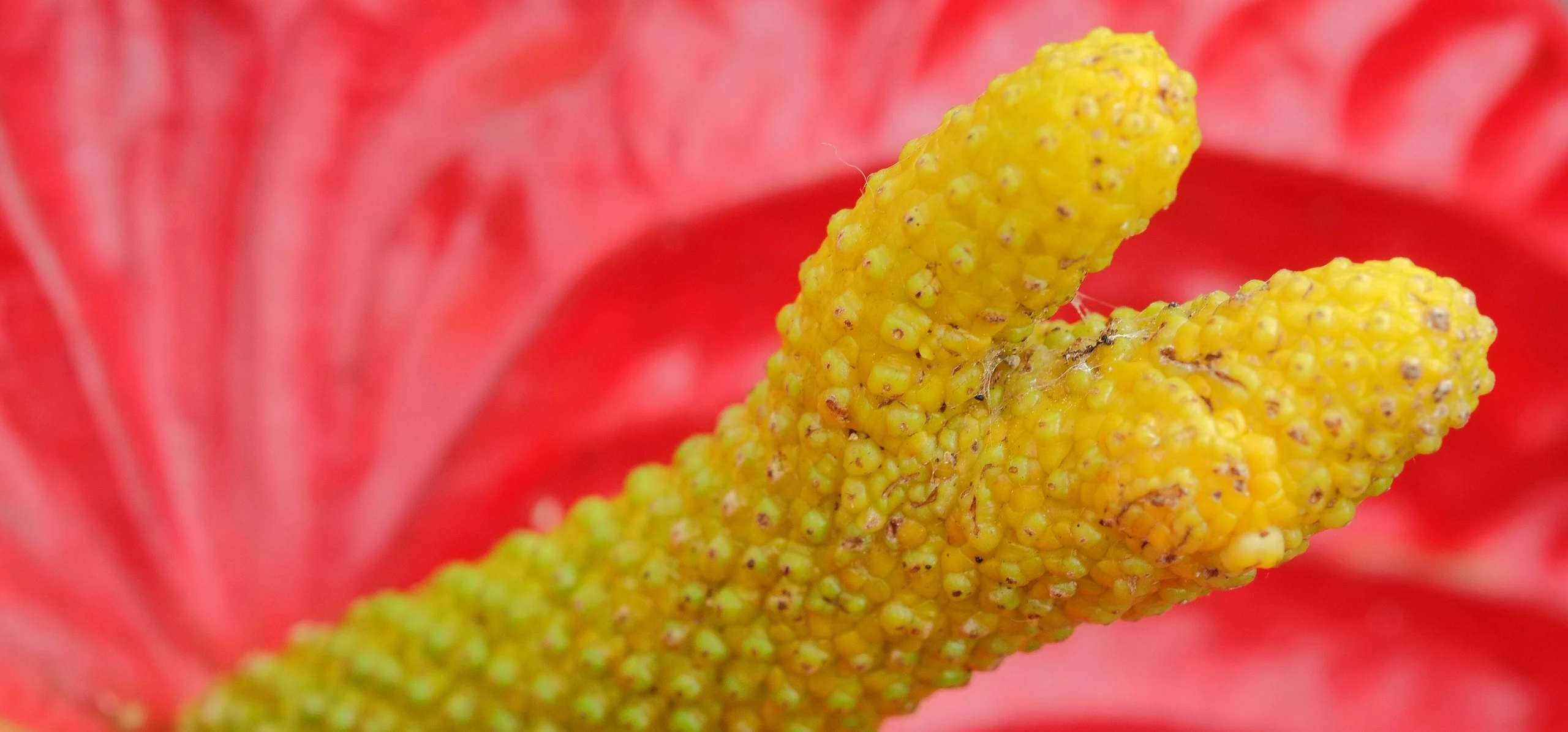
FloweringGrown chiefly for its foliage and corm; arum-type flower spathes are inconspicuous and rarely seen in cultivation
Dormancycorm dry-dormant over winter where lifted
Time to maturitycorm matures in about 7 months
Soil & climate
- Soil types
- humus-rich loam, wet or poorly draining soil
- Drought tolerance
- No
Light & Placement
- Origin
- Tropical Asia, from India to South China and Sumatra; long naturalized pantropically
- Where to place it
- Full sun to part shade bed, sheltered from strong wind
- Pond margin with up to 15 cm (6 in) of water over the corm
- Large container with rich, moisture-retentive compost, watered daily in heat
Safety
- Toxicity
- CatsToxic
- DogsToxic
- HorsesToxic
- HumansToxic
Invasive speciesnaturalized and locally invasive in warm-climate wetlands, including parts of the southeastern United States
Data fromColocasia esculenta (L.) Schott, GBIF BaColocasia esculenta (L.) Schott, Plants Toxic and Non-toxic Plants: Taro (ColocaColocasia esculenta (taro), RHSColocasia esculenta, Missouri Botanical
Where it grows
World distribution
Taro is native to 11 countries: Bangladesh, Bhutan, China, India, Indonesia, Laos, Malaysia, and Myanmar (Burma)….GBIF records 23,146 documented identifications across 155 countries, with the largest concentrations in United States, Portugal, and Taiwan.
- Bangladesh
- Bhutan
- China
- India
- Indonesia
- Laos
- Malaysia
- Myanmar (Burma)
- Nepal
- Taiwan
- Thailand
Yellow to orange dots: concentration of documented identifications per country. Green countries: sourced native range. Source: GBIFNative range from POWO (Kew).
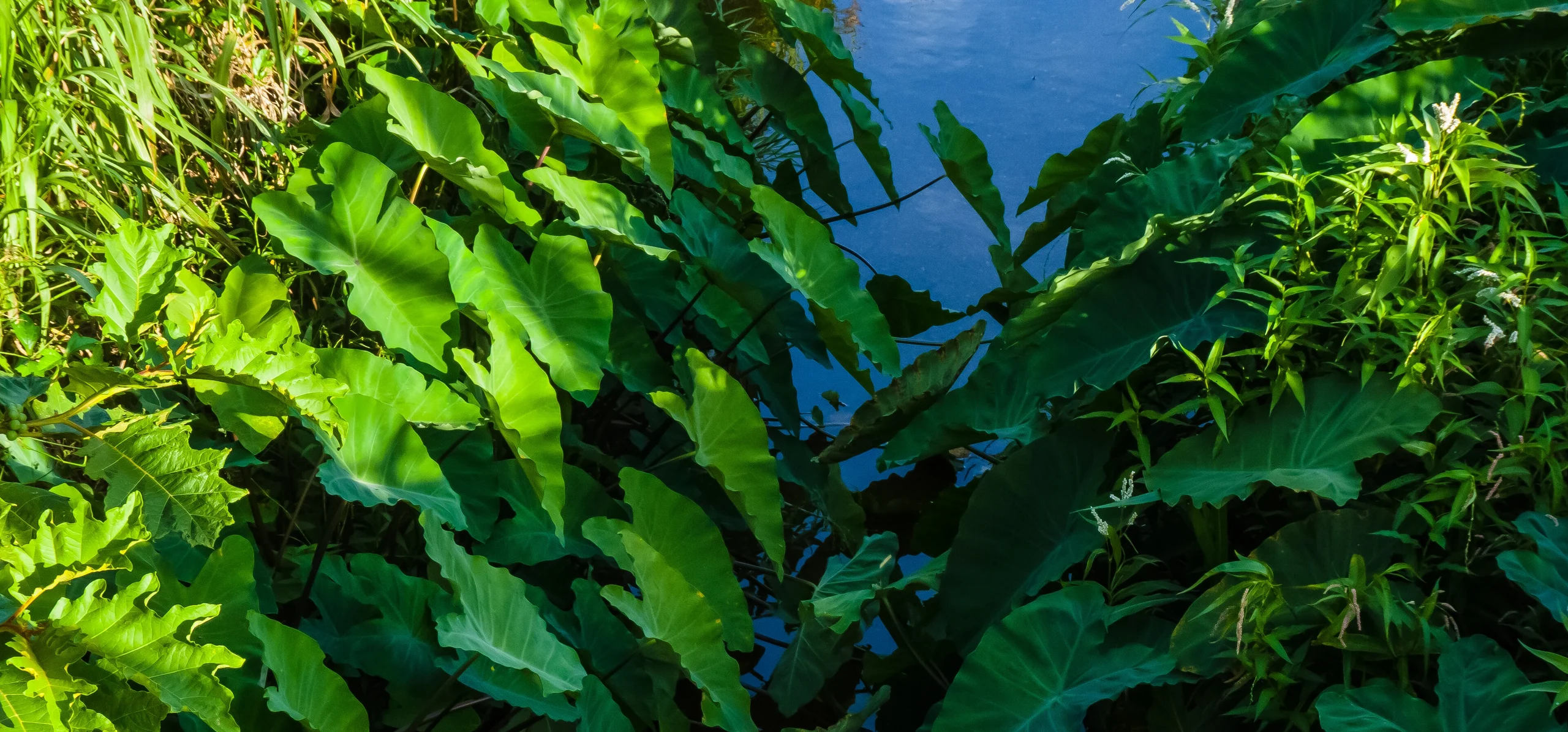
Colocasia esculenta, sold as taro or elephant ear, is not really a border perennial: it is a wetland aroid that has been grown for its edible corm for thousands of years and, more recently, for the huge arrow-shaped leaves that make it one of the most reliable large foliage plants for a pot or a pond edge. Every leaf grows from a single underground corm that swells through the season and has to either overwinter in frost-free ground or be lifted before the first hard freeze. It is also one of the thirstiest plants an ordinary garden bed will hold, tolerating several inches of standing water at a pond margin, and every part of the raw plant is loaded with calcium oxalate crystals that make it dangerous to chew, whether the chewer is a curious dog or a hungry human mistaking it for a vegetable. The rest of this guide covers watering and feeding that thirst, lifting and storing the corm, choosing a variety such as the near-black 'Black Magic', and the two-sided story of a plant that is both a toxic ornamental and, once cooked, a staple food for over a hundred million people.
A Wetland Aroid With Many Names
Colocasia esculenta's accepted native range, per Plants of the World Online, runs from India across to South China and Sumatra, and the species has been carried by cultivation into practically every tropical and subtropical region since, which is why sources disagree about where it is native versus long naturalized. GBIF records Taro, Wild Taro and cocoyam as its English common names, and its long history as a crop shows in the pile of Latin synonyms attached to it, among them Arum colocasia, Arum esculentum and Alocasia illustris, all folded into the single accepted name Colocasia esculenta (L.) Schott. In the garden trade it is almost always sold as an ornamental foliage plant or pond marginal rather than a food crop, even though it is the same species grown across Hawaii, West Africa and Southeast Asia for poi and other taro dishes.
Choosing a Variety: Green Species or 'Black Magic'
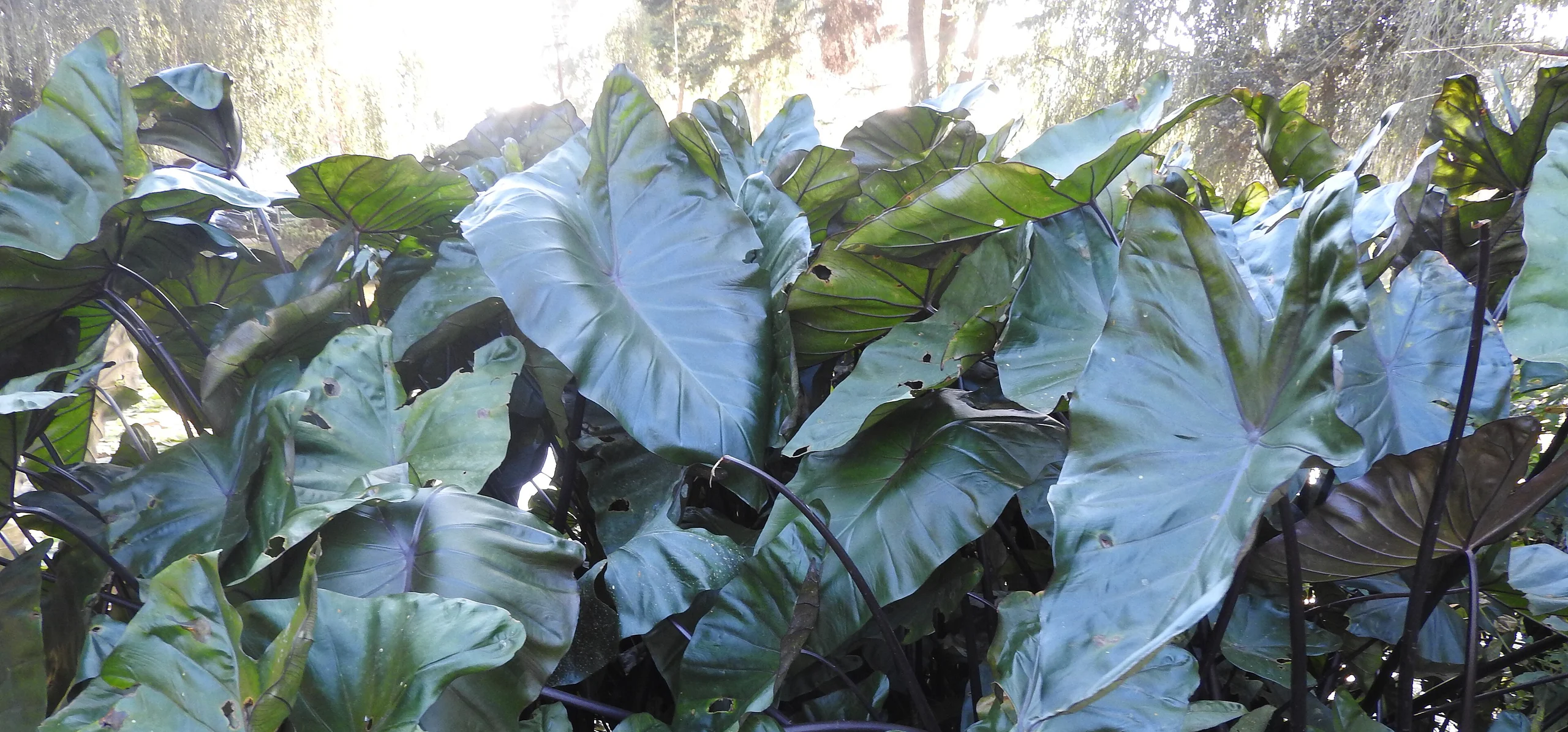
The wild-type species has plain, rich green, heart- to arrow-shaped leaves that can reach roughly 60 cm (2 ft) long on stalks nearly as long again, on a clump that typically reaches 0.9 to 1.8 m (3 to 6 ft) tall and as wide. 'Black Magic' is the cultivar most gardeners actually plant: its leaves emerge green and darken with age to a smoky purple-black on purple-black stems, and the more sun it gets, the deeper that color becomes, while a shaded plant stays a duller olive-purple. Other named cultivars, 'Mojito' with green leaves splashed purple-black, chartreuse 'Elena', 'Tea Cup' with a leaf shaped to hold water like a bowl, are bred purely for foliage effect and are no more or less hardy than the species. None of this changes the corm underground: every cultivar carries the same calcium oxalate load as the wild species.

Light and a Genuinely Heavy Thirst
Full sun to part shade suits Colocasia esculenta, with afternoon shade worth giving it where summer heat is intense; deep shade mostly produces smaller, paler leaves rather than killing the plant outright. Water is the harder requirement to get right by ordinary garden habits: the soil should never be allowed to dry out during the growing season, and the plant is one of the few ornamentals that genuinely thrives with its corm sitting in up to about 15 cm (6 in) of standing water at a pond margin. A container-grown plant left to dry out even once tends to show it within a day, first as drooping leaf stalks and then as scorched margins on the oldest leaves, and the fix is simply to water more often, since root rot is rarely the failure mode with this species.
Soil, Pots and Planting at the Pond Edge
Fertile, humus-rich soil that stays medium to wet, rather than anything fast-draining, is what Colocasia esculenta wants in the ground, and a spot sheltered from strong wind keeps the big leaves from shredding. In a container, a rich, moisture-retentive compost in a pot generously sized for the eventual clump gives the corm room to bulk up over a season, and because the plant tolerates standing directly in shallow water, it works just as well set at the edge of a pond with its base barely submerged. Either way, this is a plant that fills its space quickly and is usually planted as a single dramatic specimen or in a small group rather than massed as a groundcover.
Feeding a Plant That Grows as Fast as It Drinks
New growth on Colocasia esculenta is rapid and leaf-hungry: a weekly feed with a high-nitrogen liquid fertilizer through the growing season, as the RHS recommends, keeps new leaves coming in at full size instead of tapering off smaller. Container plants exhaust the nutrients in a pot of compost within weeks at this rate of growth and need feeding on the same weekly schedule as plants in open ground, not less. A plant producing progressively smaller leaves through summer despite regular watering is almost always underfed rather than pot-bound or diseased.
Lifting and Storing the Corm Over Winter
Where winters stay mild, in roughly USDA zones 8 to 10, the corm can be left in the ground year-round under a mulch layer through the coldest weeks. Anywhere colder, cut the foliage back once the first frost blackens it, lift the corm with a fork, and let it dry for a day before packing it in barely damp peat or wood shavings; the Missouri Botanical Garden recommends a cool, dry storage spot that never drops below about 7 degrees C (45 degrees F), since a true freeze kills the corm outright. Where a frost-free greenhouse or conservatory is available, the whole potted plant can simply move under cover for winter instead of being lifted and dried. Replant outdoors, or bring pots back out, once the danger of frost has passed the following spring.
Raw Toxicity Versus the Cooked Staple
Every part of the raw plant, corm included, is packed with needle-shaped calcium oxalate crystals, and the ASPCA lists Colocasia esculenta as toxic to cats, dogs and horses, with symptoms including intense oral burning, drooling, vomiting and difficulty swallowing after a chewed leaf or piece of corm. The same crystals make raw taro just as unpleasant for people: bitten raw, the corm and leaves burn the mouth and throat, which is exactly why every culture that eats taro as a staple, from Hawaiian poi to West African fufu, cooks it thoroughly first, since heat breaks the oxalate crystals down into a form the body tolerates. This is worth spelling out for anyone growing it purely as an ornamental: the corm looks like a food crop because it is one, but only after cooking, never pulled from the pot and eaten raw.
Invasiveness in Warm Wetlands
Outside temperate gardens, where frost keeps it firmly confined to a pot or a lifted corm, Colocasia esculenta has escaped cultivation and become a genuine wetland weed in warm regions, forming dense stands along waterways and in reservoirs in parts of the southeastern United States, among other places, where it crowds out native marginal plants. In a cold-winter garden this risk stays essentially theoretical, since an unprotected corm cannot survive winter outdoors and any offset that escapes dies back with the first hard frost. Gardeners in zone 8 and warmer, where the corm is hardy in the ground, are the ones who should avoid planting it directly in or near natural waterways and should bin lifted corms and offsets rather than tip them onto a compost heap that drains toward a stream or pond.
Test your plant knowledge
Tap a card to flip it and reveal the answer.
Colocasia esculenta corms and leaves are safe to eat raw as long as they are washed first. Tap to reveal ✕ False
In roughly USDA zones 8 to 10, the corm can stay in the ground year-round instead of being lifted for winter. Tap to reveal ✓ True
The ASPCA lists Colocasia esculenta as non-toxic to cats, dogs and horses. Tap to reveal ✕ False
'Black Magic' colors up darkest, closer to purple-black, when it gets more sun. Tap to reveal ✓ True
Colocasia esculenta has escaped cultivation and become invasive in wetlands of the southeastern United States. Tap to reveal ✓ True
Sources
References consulted for this guide
- Colocasia esculenta (L.) Schott, GBIF Backbone Taxonomygbif.org
- Colocasia esculenta (L.) Schott, Plants of the World Online (Kew)powo.science.kew.org
- Toxic and Non-toxic Plants: Taro (Colocasia esculenta), ASPCAaspca.org
- Colocasia esculenta (taro), RHSrhs.org.uk
- Colocasia esculenta, Missouri Botanical Garden Plant Findermissouribotanicalgarden.org
- Reference entity : Wikipédiaen.wikipedia.org