Garden Pea
Lathyrus oleraceus
Family · Fabaceae
Sow garden peas once soil reaches 10C, fit tendril supports before seedlings need them, and water hard at flowering to fill the pods, not just watch them grow.
Lathyrus oleraceus
Plant profile
- WateringModerateWater every 4 days
- Light exposureFull sun
Growth
- Family
- Fabaceae
- Life cycle
- Annual
- Growth speed
- 7/10
- Mature size
- 45–180 cm
- Spread
- 50–100 cm
- Flowering
- White, pink or mauve flowers in spring and summer, 1 to 3 per stalk
- Propagation
- Seed
DormancyNone; completes its life cycle within one growing season
Time to maturityAbout 50 to 70 days, or 12 to 16 weeks depending on type, from sowing to first harvest
Soil & climate
- Soil pH
- pH 5.8–7
- Drought tolerance
- No
Soil typesChalk, clay, loam or sand, moist but well-drained, Enriched with compost or well-rotted manure before sowing
Light & Placement
- Origin
- Mediterranean to Afghanistan
- Where to place it
- Bright windowsill or coldframe for an early sowing in pots, before planting out
- Open ground or raised bed, full sun, sheltered from wind
- Deep container for dwarf, no-support varieties; check moisture daily in warm weather
Safety
- Pet safe
- Yes
ToxicityNot listed by the ASPCA under this name; edible pods and seeds, unlike the unrelated, toxic ornamental sweet pea (Lathyrus odoratus)
Data fromLathyrus oleraceus Lam., GBIF Backbone THow to grow peas, RHS Grow Your OwnPisum sativum, garden pea, RHS PlantsA Gardener's Guide to Peas, Penn State EPeas, Illinois Extension Home Vegetable
Where it grows
World distribution
Garden Pea is native to 25 countries: Afghanistan, Albania, Algeria, Bulgaria, Croatia, Cyprus, Egypt, and France….GBIF records 146,673 documented identifications across 155 countries, with the largest concentrations in Germany, Afghanistan, and Sweden.
- Afghanistan
- Albania
- Algeria
- Bulgaria
- Croatia
- Cyprus
- Egypt
- France
- Georgia
- Greece
- Iran
- Iraq
Show 13 more countriesShow fewer countries
- Italy
- Lebanon
- Libya
- Morocco
- Palestinian Territories
- Portugal
- Romania
- Russia
- Spain
- Tunisia
- Türkiye
- Turkmenistan
- Ukraine
Yellow to orange dots: concentration of documented identifications per country. Green countries: sourced native range. Source: GBIFNative range from POWO (Kew).
A newly bought packet of pea seed or a seedling already reaching for something to climb is a plant that wants two things fast: cool, moist soil to root into and something thin to grip within a week or two of germinating. Garden peas are a cool-season annual, sown as soon as the soil is workable and finished before summer heat sets in, and almost every early mistake with them traces back to sowing too deep, too late, or without a support already in place. The pods you are growing toward are ready in as little as twelve weeks for the earliest types, so there is little time lost if you start again after a poor sowing.
A Name Change Worth Knowing
GBIF now files the garden pea under Lathyrus oleraceus rather than the long-familiar Pisum sativum, folding the genus Pisum into Lathyrus after DNA work showed the two were not distinct enough to stand apart. That puts the plant you eat in the same genus as Lathyrus odoratus, the ornamental sweet pea, and the two are easy to muddle by name alone. They are not the same plant: sweet pea is grown for scent and flower colour and its seeds and pods are toxic, while the garden pea in this guide is the food crop, bred for centuries for sweet, starchy or crisp pods depending on the type. Seed packets and most gardening books still say Pisum sativum, and that name is not wrong, just superseded; either name points to the plant described here.
Choosing a Type: Shelling, Snap and Snow
Shelling peas, sometimes called garden or English peas, are grown for the round seeds inside a pod too fibrous to eat; sugar snap peas have a thick, sweet pod that stays tender enough to eat whole even once the seeds inside have swollen; snow peas, or mangetout, are picked flat and young, well before the seeds inside show as bumps, and turn starchy and tough if left on the vine. Height varies as much as pod type: compact varieties such as Kelvedon Wonder or Douce Provence top out around 45cm and hold themselves up without help, while taller maincrop types climb to 1.5 to 1.8m and collapse into a tangled mat without netting or canes.
Sowing and Germination
Sow 2 to 5cm deep and about 7.5cm apart, either in a single row or in a flat-bottomed trench wide enough for three staggered rows; wait until the soil has warmed to at least 10C, since colder ground simply rots the seed rather than holding it dormant. Germination takes anywhere from six days in warm soil to over two weeks in a cold spring, and soaking the seed overnight before sowing shaves a day or two off that wait. Mice dig up and eat freshly sown seed with startling efficiency, so where that is a known problem, start seed in pots or modules undercover and transplant once the first true leaves show rather than risking a bare row outdoors.


Support and Spacing
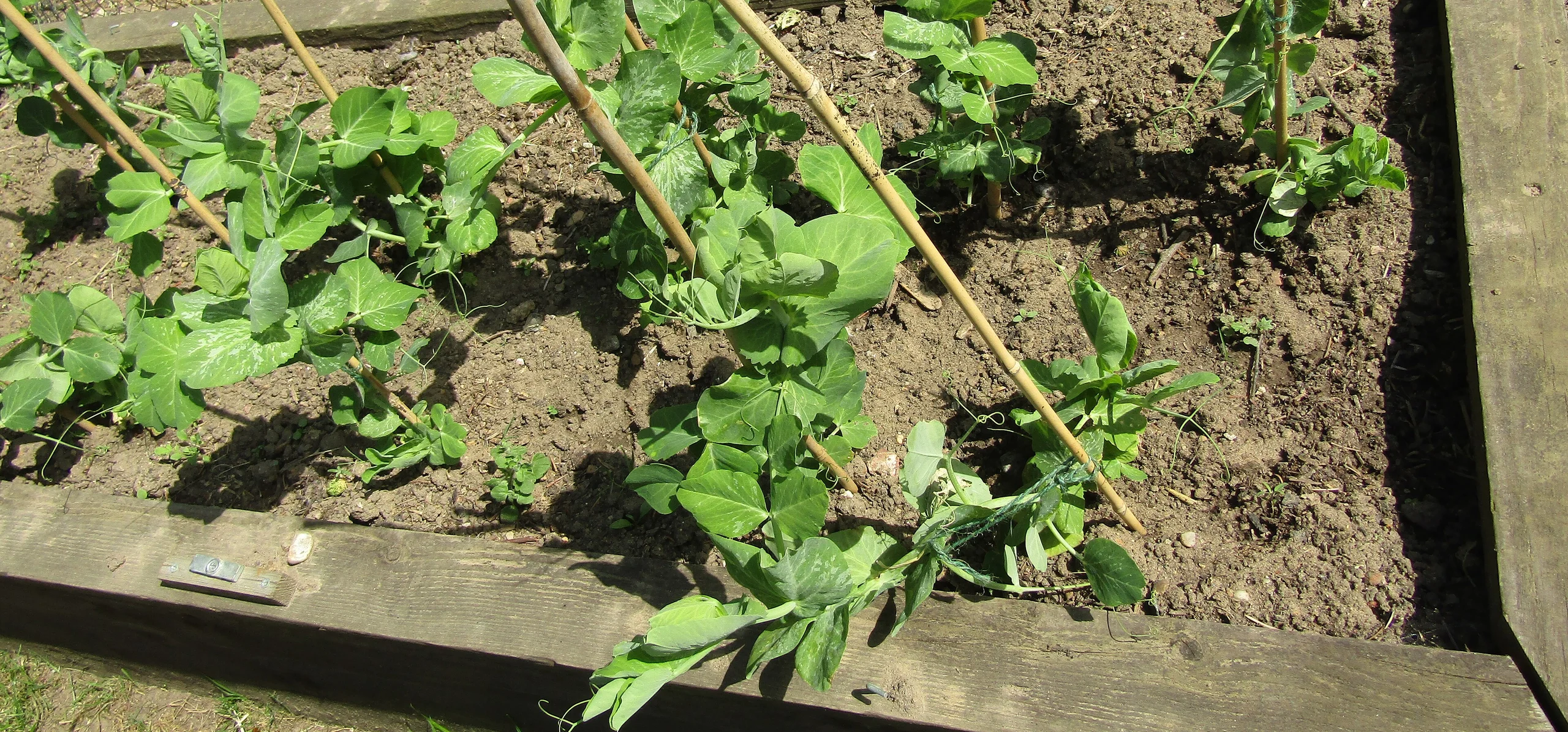
Peas climb by curling wiry tendrils at the tip of each leaf around anything thin enough to grip, not by twining the stem the way beans do, so the support has to offer something a tendril can close around within reach of the growing tip: twiggy pea sticks pushed in at sowing for dwarf types, and netting or chicken wire strung between posts for anything over about 60cm. Space rows apart by roughly the height of the variety, so a 1.2m row of maincrop peas needs about 1.2m to the next row or the far side shades out the near one by midsummer. A tendril that has found nothing to grip within a day or two starts to spiral on itself and weakens, so get the support in before, not after, the seedlings need it.
Sun, Soil and Watering
Peas want a sheltered spot in full sun, since wind rocks tall rows loose from their supports and cold pockets slow flowering. They tolerate chalk, clay, loam or sand as long as it drains while staying moist, with a pH between about 5.8 and 7; forking in a couple of bucketfuls of compost or well-rotted manure per square metre before sowing carries most crops through without extra feeding. Water at the soil rather than over the leaves, since wet foliage is the fastest route to mildew. The one watering that matters most comes as the first flowers open: a thorough soak then, repeated about two weeks later while pods are filling, does more for yield than watering little and often through the rest of the season, and roughly an inch a week covers most of that need if rain falls short.
Flowering, Pod Fill and Harvest
Flowers open white, pink or mauve depending on variety, one to three on a stalk, and each fertilised flower swells into a pod holding five to ten peas. Timing to first harvest spans roughly twelve weeks for the earliest types to sixteen weeks for maincrops, or about fifty to seventy days in general terms; a plant left to ripen its first pods to full maturity slows down on setting new ones, so picking little and often, every two or three days once cropping starts, keeps the vines producing longer than a single big harvest at the end. Pick shelling peas once the pod feels round and firmly filled but still bright green, snow peas at around 5 to 7.5cm long before the seeds show as bumps, and sugar snaps once the whole pod is plump and glossy rather than flat.
Common Pests and Diseases
Beyond mice at sowing, pigeons strip young shoots down to bare stems where they can reach a row, so netting matters as much for seedlings as for ripening pods; slugs and snails do the same damage lower down. Pea moth caterpillars hatch from eggs laid on open flowers and tunnel into the developing pod, leaving a maggot inside peas that looked clean from the outside, a problem worse on crops flowering through early to midsummer than on very early or very late sowings. Pea and bean weevil notches a neat scalloped edge along leaves, usually more unsightly than damaging on an established plant. Powdery mildew, a pale dusty coating across leaves and stems, builds up on dry soil and crowded rows late in the season; spacing plants for airflow and keeping the root zone from drying out does more to prevent it than any spray applied afterward. On heavy, poorly drained ground, fusarium wilt and root rot can yellow and stunt whole rows, one more reason peas want soil that drains even while staying moist.
After Harvest: Feeding the Next Crop
Pale nodules along the roots host rhizobia bacteria that pull nitrogen from the air and store it in a form the plant, and later the soil, can use; a healthy row has visibly knobbly roots rather than smooth ones if you dig one up to check. When the crop is finished, cut the plants off at soil level instead of pulling them, leaving those nitrogen-rich roots to break down in place. Following with a nitrogen-hungry crop such as brassicas in the same ground the next season puts that stored nitrogen straight to use, one of the few genuinely free inputs available in a vegetable rotation.
Test your plant knowledge
Tap a card to flip it and reveal the answer.
Garden pea pods and seeds now sit in the same genus, Lathyrus, as the toxic ornamental sweet pea. Tap to reveal ✓ True
Peas climb by twining their whole stem around a support, the way runner beans do. Tap to reveal ✕ False
The most important time to water peas is while the flowers are open and the pods are filling. Tap to reveal ✓ True
Cutting spent pea plants off at soil level instead of pulling them helps the next crop. Tap to reveal ✓ True
Dwarf pea varieties such as Kelvedon Wonder or Douce Provence need netting or tall canes to crop well. Tap to reveal ✕ False
Sources
References consulted for this guide
- Lathyrus oleraceus Lam., GBIF Backbone Taxonomygbif.org
- How to grow peas, RHS Grow Your Ownrhs.org.uk
- Pisum sativum, garden pea, RHS Plantsrhs.org.uk
- A Gardener's Guide to Peas, Penn State Extensionextension.psu.edu
- Peas, Illinois Extension Home Vegetable Gardeningextension.illinois.edu
- Reference entity : Wikidatawikidata.org