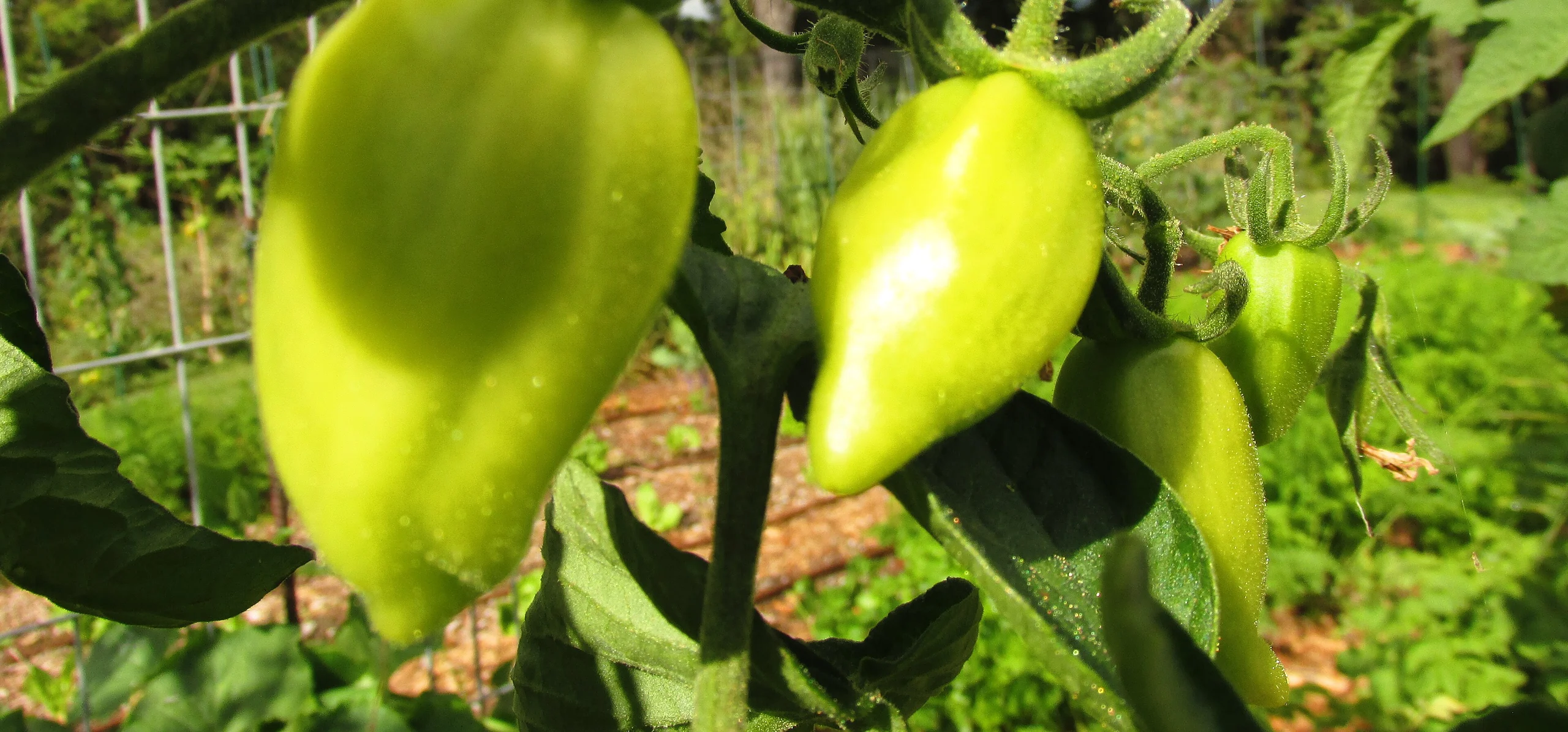
Tomato
Solanum lycopersicum
Family · Solanaceae
Tomatoes need steady moisture, a pH near 6.0 to 6.5 and the right pinching method for the variety; here is why plants split, rot or sprawl when that slips.
Solanum lycopersicum
Plant profile
- WateringHighWater every 3 days
- Light exposureFull sun
- Hardiness zoneUSDA 10–11
Growth
- Family
- Solanaceae
- Life cycle
- Perennial
- Growth speed
- 7/10
- Mature size
- 90–183 cm
- Spread
- 61–91 cm
- Flowering
- Small yellow flowers followed by fruit trusses from midsummer onward (RHS)
- Propagation
- Seed
DormancyPerennial in its native range but killed by frost within its first year almost everywhere else, so it is grown as an annual outside zones 10 to 11 (Missouri Botanical Garden)
Time to maturityCropping begins from midsummer onward, earlier and for longer under glass than outdoors (RHS)
Soil & climate
- Soil pH
- pH 6–6.5
- Soil types
- loam, well-drained
- Drought tolerance
- No
Light & Placement
- Origin
- Peru, as a cultigen (POWO)
- Where to place it
- Bright, south-facing greenhouse border for an earlier crop (RHS)
- Full-sun bed or border sheltered from wind (RHS)
- Warm patio or balcony spot for a growing bag or large pot (RHS)
- One plant per 30 to 45 cm (12 to 18 in) pot, or two plants per standard growing bag (RHS)
Safety
- Toxicity
- CatsToxic
- DogsToxic
- HorsesToxic
Data fromSolanum lycopersicum L., GBIF Backbone TRHS: How to grow TomatoesMissouri Botanical Garden Plant Finder: ASPCA: Toxic and Non-Toxic Plants, TomatAlabama Cooperative Extension System: Bl
Where it grows
World distribution
Tomato is native to a single country: Peru.GBIF records 113,273 documented identifications across 217 countries, with the largest concentrations in United States, United Kingdom, and Afghanistan.
- Peru
Yellow to orange dots: concentration of documented identifications per country. Green countries: sourced native range. Source: GBIFNative range from POWO (Kew).
Cordon or Bush: What You Are Actually Growing
A tomato seedling bought in spring gives few clues about what it becomes. Solanum lycopersicum reaches 0.9 to 1.8 m tall and spreads 0.6 to 0.9 m at a fast rate, and in its native range it grows as a short lived perennial; almost everywhere else, the first frost ends the plant for good (Missouri Botanical Garden). Cordon, or indeterminate, varieties keep extending all season and can reach 1.8 m, so they need a tall cane, string or stake from the start. Bush, or determinate, varieties stay shorter and bushier and suit a pot or growing bag without any support at all (RHS). Training a cordon plant like a bush, or the reverse, wastes the pinching and staking effort the variety was never bred to need.
Sowing and Hardening Off
Seed sown for a greenhouse crop goes in from late February to mid March; for an outdoor crop, late March to early April is soon enough. Either way the seed needs a temperature of about 18°C to germinate and usually takes about a fortnight to emerge (RHS). Prick seedlings out once they carry a couple of true leaves, then keep them at a minimum of 16°C as they grow on. Do not move plants outdoors, even under cover, until daytime temperatures are reliably above 16°C, and harden them off gradually first so the leaf tissue can adjust to outdoor light and wind before it has to cope with both at once.
Spacing, Pots and Site
In open ground, space plants 45 to 60 cm apart so foliage can dry between waterings. In containers, one plant needs a 30 to 45 cm pot on its own, or two plants share a standard growing bag (RHS). Missouri Botanical Garden's profile calls for full sun and an average, medium moisture, well drained soil, and notes the plant does best in a moist, humus rich, fertile loam, the opposite of a soil that dries out between waterings or stays waterlogged after rain. A greenhouse border or a warm, sheltered patio bed both meet that brief; a shaded corner or a spot that floods after heavy rain does not.


Watering Without Triggering Blossom End Rot
Blossom end rot, the sunken, leathery patch that appears on the base of developing fruit, is a calcium deficiency inside the fruit itself, not usually a lack of calcium in the soil. Because calcium does not move freely within plant tissue, even a short gap in watering followed by a heavy soak is enough to interrupt calcium uptake at the exact moment the fruit needs it (Alabama Cooperative Extension System). The same extension guidance keeps soil pH at 6.0 to 6.5 and aims for around 1.5 inches of water a week once plants are fruiting, applied evenly rather than in a single deluge after a dry week. RHS adds that containers dry out fast and may need watering daily in hot weather, and that the same fluctuating moisture that causes blossom end rot is also what makes ripening fruit split its skin.
Feeding for Fruit, Not Just Leaves
Once the first fruit trusses start to swell, RHS recommends switching to an organic, high potassium liquid feed applied every 10 to 14 days. Feeding earlier, before any fruit has set, mostly grows leaf and stem at the expense of flowering, since nitrogen-heavy growth compounds are what young plants pull from a balanced feed. Fortnightly feeding through the fruiting period is enough to keep trusses filling out without pushing the soft, disease-prone growth that comes from overfeeding.
Pinching Out Side Shoots on Cordon Types
Cordon tomatoes throw out side shoots from the joint between each leaf and the main stem, and RHS advice is to pinch these out or snap them off as soon as they appear, keeping the plant to one productive stem rather than a sprawling, self-shading bush. Once a plant reaches the top of its support, or has set seven fruit trusses under glass or four outdoors, RHS advises removing the growing point two leaves above the top truss so the plant stops putting energy into new growth it will not have time to ripen. Bush varieties are not trained this way; their side shoots are part of how the plant produces its fruit.
Diseases, Pests and the Toxicity Confusion
RHS lists tomato blight, most common outdoors in wet summers, along with grey mould and glasshouse whitefly as the recurring problems on both cordon and bush plants. None of these explain a dog or cat getting sick after chewing a stem: the ASPCA lists tomato plant foliage, stems and unripe green fruit as toxic to dogs, cats and horses, with solanine as the toxic principle and hypersalivation, inappetence, gastrointestinal upset, weakness, dilated pupils and a slowed heart rate as the clinical signs. The same ASPCA entry is explicit that ripe fruit is non-toxic, so a pet stealing a red tomato off the vine is a different situation from one chewing on the leaves or an unripe green fruit still on the plant.
Harvest and Ripening
Cropping starts from midsummer onward, with cherry varieties ripening faster than large slicing or beefsteak types, and greenhouse plants typically cropping earlier and for longer than the same variety grown outdoors (RHS). Pick fruit as soon as it is fully coloured rather than leaving it on the vine, since ripe fruit left in place slows the rest of the truss and adds to the same moisture-driven splitting that comes from irregular watering earlier in the season.
Test your plant knowledge
Tap a card to flip it and reveal the answer.
Blossom end rot is caused by inconsistent watering interrupting calcium uptake, not usually by a lack of calcium in the soil. Tap to reveal ✓ True
RHS recommends pinching out the side shoots that grow between the leaf and main stem on cordon tomatoes. Tap to reveal ✓ True
According to the ASPCA, fully ripe red tomato fruit is just as toxic to dogs and cats as the foliage and unripe green fruit. Tap to reveal ✕ False
Missouri Botanical Garden lists tomatoes as hardy in USDA zones 10 to 11, which is why most gardeners grow them as an annual rather than a perennial. Tap to reveal ✓ True
RHS advice is to move tomato seedlings outdoors as soon as they have true leaves, regardless of temperature. Tap to reveal ✕ False
Sources
References consulted for this guide
- Solanum lycopersicum L., GBIF Backbone Taxonomygbif.org
- RHS: How to grow Tomatoesrhs.org.uk
- Missouri Botanical Garden Plant Finder: Solanum lycopersicummissouribotanicalgarden.org
- ASPCA: Toxic and Non-Toxic Plants, Tomato Plantaspca.org
- Alabama Cooperative Extension System: Blossom-End Rot in Tomatoes, Causes and Preventionaces.edu
- Reference entity : Wikipédiaen.wikipedia.org